
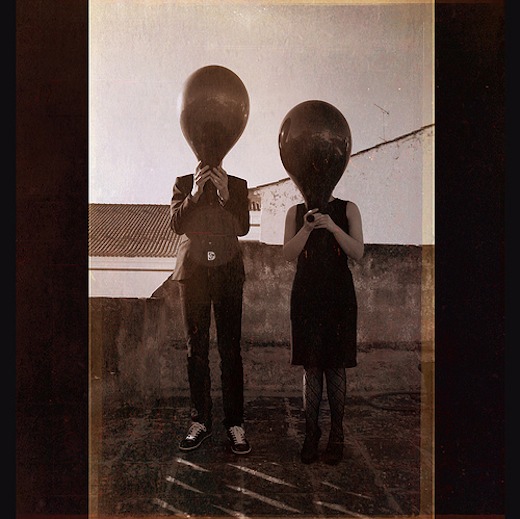
The audiovisual installation “Balunar†by Jorge Mantas (a.k.a. The Beautiful Schizophonic) and Susana Mourão, will be presented at the Museu de Évora from September 21 to 23, as part of this year’s Escrita na Paisagem festival.
New podcast: Eosin

Linnut, by Eosin, is the first of an ongoing series of compositions using vinyl lock grooves and field recordings.
Somebody asked me: what is this track about? what is its story?
I don’t know about its meaning and its story lies on the procedure of its own production. For my participation in Tinynoise festival, last October, i got two Staalplaat Soundsystem LP made for Yokomono that I was experimenting in real time during my performance, this is, I was listening for the first time and using the locked grooves, combining them with pre-recorded sounds I had already edited.
I enjoyed the result and the loops inspired me to use them as a structure for further tracks. I recorded some mixes and then edited, creating a sequence to which I added a parallel layer made of field recordings of various sources.
It’s analog and digital, improvisation and control in processed real time experiments.
Marc Behrens in Darmstadt

September 18, 2010: Participation in a symposium connected to the exhibition “Das Menschenbild in unserer Zeitâ€, organized by the artists association Darmstädter Sezession. Lectures by Martin Schneider, Annegret Soltau, Dr. Wolfgang Zumdick and Marc Behrens. Kunsthalle Darmstadt, Steubenplatz 1, 64293 Darmstadt, Germany.
“Passeports†reviewed by Cyclic Defrost

As the title implies Passeports by Matias Delplanque is concerned with geography, particularly locis of transport – train stations, harbours, parking lots – in the cities of Nantes, Lille and Dieppe, France. Delplanque works by processing field recordings from these locations, softening them into gauzy, cushioned blurs, identifiable traces peeking through the haze. Elements of Delplanque’s domestic environment intermingle with the outdoor material, so the clink of cutlery, stationary, and family footsteps cross paths with motor hum and wind.
It’s Delplanque’s way with processing, his ability to locate and extract a form of wispy wistfulness from his sources, that makes Passeports such a compelling album. Despite this intervention the integrity of his sources remains intact, and the impact is comparable to the editing of Francisco Lopez. In ‘Passeport 1 (Nantes)’ the abstract din of external sound slowly escalates in volume, like a slow fade in cinema, or the gradual opening of a theatrical curtain. This reveals a quiet rumble, possibly a plane taking off, amid the whispered rattle of close objects and oscillating waves of smoky drone. ‘Passeport 2 (Lille)’ employs the same technique to the sound of rain, as passing cars (possibly) speed by on an overhead bridge. ‘Passeport 5 (Lille)’ sounds somehow sadder, streaming waves of sand growling like Flying Saucer Attack. The final ‘Passeport 7 (Nantes)’ involves more staccato sounds, sparse droplets and indistinct chirrups, all popping like Pole on summer-camp, before dense streams of chattering voices intrude – sourced from a call centre in New Delhi. This reveals even greater depths to Delplanque’s compositional approach. Joshua Meggitt
via Cyclic Defrost
“Passeports†reviewed by RifRaf
Ami lecteur, toi qui apprends par coeur les articles de RifRaf, tu n’as pas oublié qu’en juin dernier, nous nous étions enthousiasmes pour ‘Circonstances / Variations 1-4’ – les très belles relectures dub que Mathias Delplanque avait signée d’un de ses titres lorsqu’il se cache sous le pseudo de Lena. allons droit au but, le musicien français est tout autant formidable quand il signe ses oeuvres sous son propre blaze, dans un genre tout différent (pour faire simple, la musique concrète ambient).
Composé à partir de field recordings captés dans des gares, des ports, des parkings ou des aérodromes – en gros, tout ce qui a trait au transport, ‘Passeports’ sublime le quotidien par des appoints électroniques d’une sensationelle beauté – on songe à Phil Niblock ou Christian Fennesz. Sous la plume légère de Delplanque, la sirène d’une locomotive rend soixante and plus tard un écho à l’oeuvre de Pierre Schaeffer – elle tient davantage de l’extension talentueuse qu’à la simple génuflexion mortifère. Au bout des cinquante minutes, on n’a qu’une envie: boucler les valises et se replonger dans les atmosphères d’un disque admirable, muni au check-in de tous ses ‘Passeports’. Fabrice Vanoverberg
“Passeports†reviewed by Drowned in Sound
Composed from field recordings collected in transport-related zones around France – harbours, car parks and train stations – Mathias Delplanque’s album traffics in a dense ambience that tends towards the minatory, pointing up the uncertain, interstitial nature of transit. ‘Passeport 1 (Nantes)’ rolls out corrupted foghorn calls one over the other, with rattling train carriages picking their way between their dense sonic mass. The effect is powerful, but perhaps nothing particularly new. It’s amid the massed brassy rumbles of ‘Passeport 2 (Lille)’ and the dripping, organic bliss of ‘Passeport 6’ – a little reminiscent of Rosy Parlane’s Jessamine – that the real distinction of this work becomes apparent. Chris Power
via Drowned in Sound
Soon in Crónica

Marc Behrens in London
September 13 to 16: “Field Studies†– a four-day summer workshop exploring architecture and the city through listening and recorded sound, led by Justin Bennett, John Levack Drever and Marc Behrens. Faculty of Architecture and Spatial Design, London Metropolitan University. Organised by Musarc.
Gintas K live in Vilnius

Stephan Mathieu live in San Francisco

Stephan Mathieu will perform an extended version of Alvin Lucier’s Music with Magnetic Strings during the SFEMFs eleventh edition at the Brava Theater Center. September 11th in San Francisco, California.