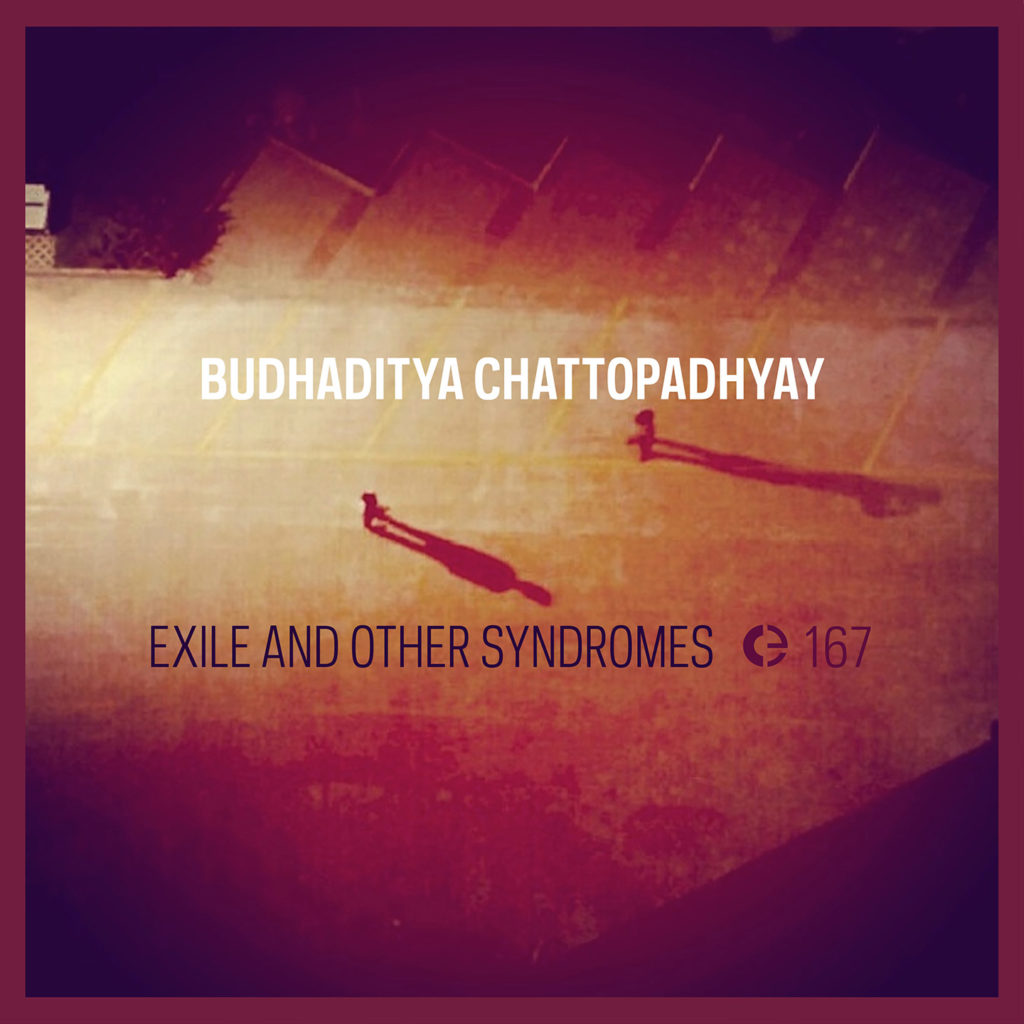
New release: Budhaditya Chattopadhyay’s “Exile and Other Syndromes”

Crónica is proud to present the new release from Budhaditya Chattopadhyay, Exile and Other Syndromes, now available to stream or download.

Exile and Other Syndromes is the stereo mix-down of an interactive and generative audiovisual installation that responds to the current indisposition of migration, mobility, placeless-ness and nomadism, which are considered as the impulses of a contemporary condition that eventually blurs the boundaries between the local and the global, the digital and the corporeal, the private and the public, or the intimate and the dehumanizing spaces, instilling a sense of semantic fatigue. The composition aims to transmute the contemporary city’s volatile, oppressing and tensed environments to encourage the contemplation and poetic musings of the listening subject navigating the intercepting urban spaces. This specific method of artistic intervention examines the way memory, imagination and subjectivity of an itinerant listener elaborates the character of sound in the context of intensified urban interaction, mobility and nomadism. The work relies on intuitive capacities of listening rather than the ontological and epistemological reasoning involved in deciphering the immediate meaning of sound, helping to relate to these dehumanizing urban sites through a poetic presence. This belief in inward contemplation and subjective formation available to the urban listeners enables the work exploring the poetic-contemplative rupture to counter the neurosis of contemporary urban living. The particular emphasis on the poetic attributes of an expanded mode of listening provides with a context for exploring the unexpected splendor of everyday sounds and their transcendental potential. Emergence of contingent moments in the urban listening experience expands the Cagean idea of chance composition towards a fluid and nomadic interaction with these everyday urban sounds.

This project was conceived in an artist residency (2015–6) at the Institute of Electronic Music and Acoustics – IEM, supported by the University of Music and Performing Arts Graz. The premiere of the prototype took place at CUBE, IEM, on 19 January 2016. The full version of the work was installed publicly during the festival Nacht van Kunst & Kennis, Leiden in September 2017, exhibited (along with 3-channel live visuals) at the Rogaland Kunstsenter as part of the Screen City Biennial, Stavanger, Norway, 12–31 October 2017; and as The Unspoken, The Ineffable at Serendipity Arts Festival, Goa, December 2018. The Ambisonics composition was performed live at Irtijal, International Festival for Experimental Music in Beirut, and Convergence festival 2019, De Montfort University.

Exile and Other Syndromes is now available for stream or download!

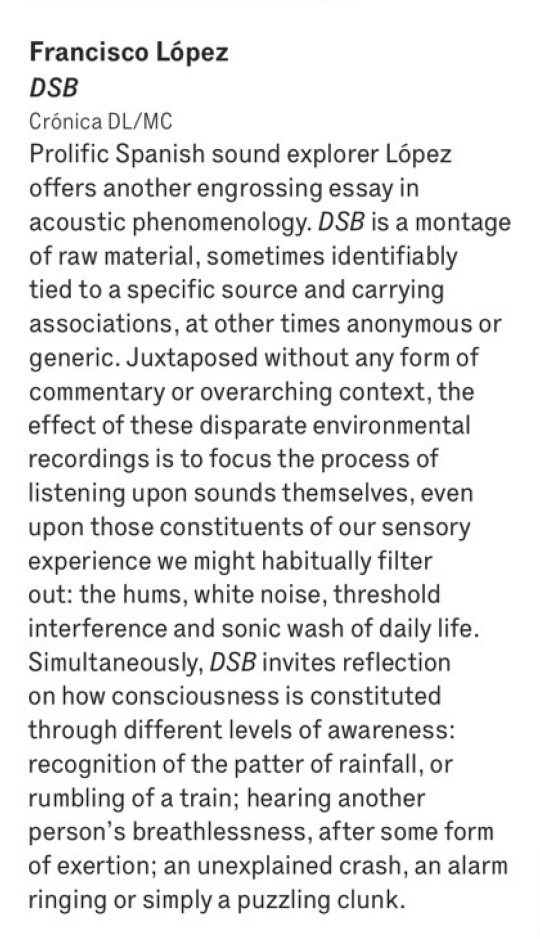
Francisco López’s “DSB” reviewed by Felthat

Francisco Lopez is a man institution. Creatively active in the field recording and musique concrete, he elevated the art of both to something completely different. His newest album is no different but definitely somewhat of a surprise. 

The processing of the field recordings is his trademark – you might be surprised how nuanced and elaborate it can be – here we have lots of difficult to distinguish soundscapes, sometimes quite raw and noisy. There is a lot of realism to his narrative, and especially in terms of watery sounds and sounds related to anything that has to do with water. It’s a persistent exploration, a sure hand of choice to the sound and compiling them together is both resonating and dramatic.

New release: Francisco López’s “DSB”

This is not music? Says who? Try to imagine an astonishing reversal of the traditional widespread subservience of sound to storytelling: instead of sound effects providing realism to a narrative, the open shell of an apparent narrative becoming sound work… or perhaps even a new form of weird experimental music that only requires a willingness to listen to the actual sonic matter itself, precisely when it appears to be something else.

Francisco López is internationally recognized as one of the main figures of the audio art and experimental music scenes. For forty years he has developed an astonishing sonic universe, absolutely personal and iconoclastic, based on a profound listening of the world. Destroying boundaries between industrial sounds and wilderness sound environments, shifting with passion from the limits of perception to the most dreadful abyss of sonic power, proposing a blind, profound and transcendental listening, freed from the imperatives of knowledge and open to sensory and spiritual expansion. He has realized hundreds of concerts, projects with field recordings, workshops and sound installations in over seventy countries of the six continents. His extensive catalog of sound pieces -with live and studio collaborations with hundreds of international artists- has been released by over 400 record labels and publishers worldwide. Among other prizes, López has been awarded five times with honorary mentions at the competition of Ars Electronica Festival and is the recipient of a Qwartz Award for best sound anthology.

Tracklist:

  1. DSB-A (23:53)
  2. DSB-B (18:46)

“DSB” is now available as a limited-release cassette and for download or stream.

Francisco López’s “DSB” reviewed by Aural Aggravation

From the very opening seconds, Francisco López’s latest offering assails the ears and scorches the brain: the first track – which hits the magical running time of twenty-three minutes – is nothing short of explosive – literally. Opening with a roaring blast of brutal harsh noise, it soon separates into a series of samples and sounds, whereby propeller engines swoop low, spitting machine-gun fire and dropping detonations all around and bomb blasts tear the air. I’ve previously described certain noise works as sonic blitzkriegs, but this is actually nothing short of total war – captured in audio. 

DSB is the accumulation of a decade’s work, which was, apparently, created at ‘mobile messor’ (worldwide), 2009-2019. Mixed and mastered at ‘Dune Studio’ (Loosduinen), 2020.According to the press release, López’s objective over the forty years of his career to date is to ‘Destroy boundaries between industrial sounds and wilderness sound environments, shifting with passion from the limits of perception to the most dreadful abyss of sonic power, proposing a blind, profound and transcendental listening, freed from the imperatives of knowledge and open to sensory and spiritual expansion’.

But with DSB, López doesn’t just destroy boundaries. It destroys everything in an obliterative sonic attack that’s sustained for some forty-five agonising minutes. 

When it does pull back from the eye-popping extremes, it presents a dank, ominous atmosphere, and one minute you’re underwater, as if being drowned, the next, your head’s above water and you’re surrounded by a roaring sonic assault that lands blows from all sides. The quieter moments are tense and oppressive, and with unexpected jolts and speaker-shredding blasts.

A low rumble and clodding thuds and thunks, like slamming doors and hobnail boots create a darkly percussive aspect that dominates the start of DSB-B… but then you’re under water again and everything is muffled… you can’t hear or breathe, but all around there are bombs and you’re feeling the vibrations in your chest. It’s all too close and you’re terrified. It’s eighteen and three-quarter minutes of ominous atmospherics and tempestuous crescendos of noise, raging storms with protracted periods of unsettled turbulence in between as strong winds buffet away. The dynamics are extreme, as is the experience. 

Something has clearly shifted here: López’s work a decade ago was predominantly experimental, wibbly, electronic ambient in its leanings, predominantly layerings of drones, hums, and scrapes. Interesting enough, exploratory, but not harsh. Yet DSB is so, so harsh, it’s positively brutal. But these are harsh times, and when everything is a grey monotony, same news on a roll on every outlet, the instinct is to slump into an empty rut.

DSB will kick you out of that and kick you around unapologetically, landing boots in the ribs, and then more. It will leave you dizzy and drained. But it will make you feel. And that’s essential. Christopher Nosnibor

via Aural Aggravation

Pedro Rebelo’s “Listen to me” reviewed by Neural

What do nanotechnologies, innovative industrial food safety processes and experimental music have in common? Is the ‘charm’ of certain sound environments alone enough to inspire an entire album of contemporary experimentation? Yes, if the formal result is so rich that it almost conceals the fact that its essence is simple field recordings. A residency in 2017 at the International Iberian Nanotechnology Laboratory, in Braga (Portugal), was the starting point for this project by Pedro Rebelo. Rebelo recorded sounds that came from the laboratories, machinery and broader environment of the centre. The quantity and quality of the sounds emanating from these workplaces was surprising: from the acoustic signals of the equipment, to the enormous air treatment fans, to the whistle of the liquid nitrogen used, to the millimetric precision of the ultrasounds one use for the treatment of specific substances. Rebelo’s residency resulted in a sound installation at GNRation, developing a further investigation and amalgamation of the collected sound materials. There are two pieces – respectively of about sixteen minutes each – presented in this cassette-release. Rebelo’s background as a pianist and improviser is evident in a complex musicality, rich in variations and refined juxtapositions. Pedro Rebelo has been Professor of Sonic Arts at Queen’s University Belfast since 2012 and the recipient of two major scholarships from the Arts and Humanities Research Council. One of these includes his interdisciplinary project “Sounding Conflict”, which investigates the relationships between sound, music and conflict situations. Rebelo is a specialist in the topic, boasting participatory projects involving communities in Belfast, the favelas of Maré, Rio de Janeiro, itinerant communities in Portugal and a slum city in Mozambique. Listen to me is a compelling work, and both suites feature some very evocative passages, slightly mysterious but always controlled, impeccably managed, with field recordings that almost replace individual real instruments or electronic effects. Aurelio Cianciotta

via Neural

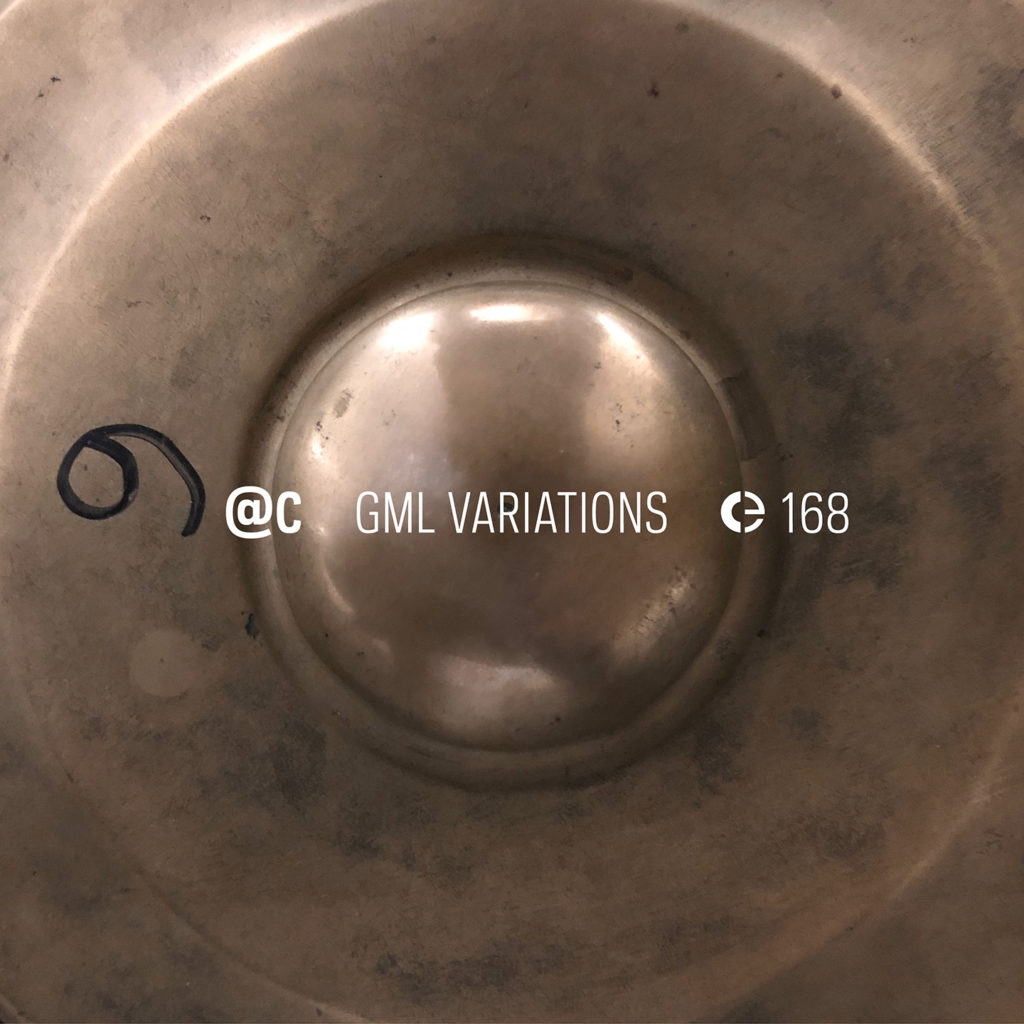
“GML Variations” reviewed by Vital Weekly

The Robotic Gamelan of Casa de Musica is just as cool as you’d imagine it is. In fact, Google it right now. Check out some photos of the thing, then meet me back here… see, isn’t that a neat thing? Gamelans are cool… robots are cool… and so a robotic gamelan is very cool. Pedro Tudela and Miguel Carvalhais are the composers behind @c and the Cronica label. In 2018, they were commissioned to write a piece called “GML 123” for the Robotic Gamelan to play; their generative digital composition activated the gamelan and introduced new sounds into the space. This album includes that piece and also four studio-created variations (the title is quite literal) and a coda. Because this is, essentially, the same piece repeated a few times, I found that it works better listened to one track at a time rather than all in one sitting. The pace and density remain similar from start to finish, which suggested to me that “GML Variations” is better considered as a collection of individual pieces than an hour+ single experience. But gamelan music is just so lovely, listening to the ringing percussion steadily morph into elongated digital smearing tones is a lot of fun. The 4th variation is my favourite; it’s the most removed from its recognizable source, 30 minutes of slow liquid volleys with hints of ringing bells and reverberant acoustic space. (HS)

via Vital Weekly

“Submerge-Emerge” reviewed by Vital Weekly

Jos Smolders was inspired to write “Submerge- Emerge” by a teenage encounter with an 1897 poem called “Un Coup de des Jamais N’Abolira le Hasard” by Stephane Mallarme. As art tends to do when a receptive kid encounters it for the first time, the poem stuck with Smolders for decades afterwards. He continued to think about it, wrestling with the poem’s meaning and the effect that it had on him. In 2016, he decided to write a piece of music based on the poem. Now, writing experimental-type music based on a poem is, generally speaking, a silly thing to do. You’ve no doubt heard endless academic pretentious tape-and-voice nonsense music based on poems. Smolders, though, has long used language as inspiration for his music, and always with a uniquely personal perspective. He’s also a thoughtful enough composer to not fall into any cliché traps. “Submerge – Emerge”, then, is one of the most exciting and beautiful albums of his career, one that I’ll keep returning to long after this review is written. The album is more about the poem’s themes and ideas than simply a sonic backing to recited text. There are long stretches with no words at all… just shimmering pools of synthesizer tones, cavernous drones and field recordings of boats, beaches, and water (an element reflected from the poem’s water imagery). The album is lovely and engaging… episodes (labelled as “interludes” and “plates”, implying parts of a book) seem to comment on one another, working both individually and as a flowing whole. There’s a lot to chew on here, whether one traces sonic elements and compositional choices back to Mallarme’s poem or not. (HS)

via Vital Weekly