New release: Ran Slavin’s “Digital Junkies in Strange Times”


Crónica is delighted to present a new release from Ran Slavin, “Digital Junkies in Strange Times”.

As early as the second decade of the 17th century, the laptop was well on its way to being a favourable solo instrument, and it very soon evolved a special virtuoso literature that included every trick usually thought of as part of the music of more recent times. Meanwhile the principle behind the laptop, as it evolved as a form, and behind all “electronic” music, for that matter, was that of instrumental color, and within this principle the laptop worked magnificently. Then in the 19th century the laptop was turned to again in the renewed interest in displays of virtuosity for its own sake, and we have the stage set for a kind of laptop concerto.

Reflected on its surface are fortresses and castles — witnesses of bygone days of knightly splendour and the vanished glory of fighting times. At the St. Johns Rapids the stream races ahead, winding through the cataracts, hewing out a path with its foaming waves through the rocky chasm into the broad river bed…

The mystery in fact can be divided into 4.

Ran Slavin’s 8th release in Crónica ranges from the subtle, delicate and personal to the almost unpredictable. Slavin’s music fluidly moves from texture-techno to dirty-ambient, from field recording to R&B and lounge, in a hypnotic spiralling soundtrack with virtual guest vocalists Songdreamer and Nicole.em.

The 59-minute digital LP is comprised of 4 tracks with durations ranging from 1.5 minutes to the 41 minute sonic universe of Moonlight Compilation, that encompasses a multitude of scenes and divergent paths within them.

Ran Slavin is a multi faceted artist who works primarily with video installation, sound and film. His work explores fiction and prismatic forms and narratives through video and sound installation and can be interpreted as an expansion of cinematic forms, usually utilising post production and compositing sensibilities as tools of subversion and reality enhancement. Slavin’s work often embraces the tension between fact and fiction, supernatural and mythical, history and futurism and compels the viewer to wander beyond reality and the immediate, into a prism of digital superposition.

A capella vocals to Sparkle ft. R. Kelly’s Be Careful & Mos Def’s Respiration by Songdreamer. A capella vocals to Isley Brother’s Let’s Fall in Love by Nicole.em. Moonlight Compilations was partly recorded during a live broadcast on www.halas.am. Thanks to Ophir Ilzetzki and Daniel Meir. Field recordings, instruments, and editing by RS. Cover by RS and MC.

“Under my Skin” reviewed by Bodyspace


Para estudar.

O título pode, à partida, parecer enganador. Só quando chegamos aos minutos finais de “Under My Skin”, tema homónimo que é um de dois pontos finais do disco, e ao sample rouco da canção de Frank Sinatra com o mesmo nome, é que percebemos que existe, aqui, algo de humano ou de carnal; que o é de forma fantasmagórica, como se a pele há muito tivesse sido abandonada, ou trocada, pelos bytes; como se nada mais restasse que a memória de uma máquina que já foi humana, upload de mente para disco rígido.

Há muito que Gintas Kraptavičius, ou Gintas K, explora a música digital – quase vinte anos. Under My Skin prossegue esse trilho laboratorial, sendo um disco no qual, mais que a vontade de fazer música, destoa a vontade de a descobrir por entre muralhas e muralhas de sons artificiais. O resultado final pode não ser, segundo os cânones, considerado música, assim como uma experiência não pode ser considerada arte. Ou talvez possa, dependendo do olhar de cada um.

Os sons aqui ordenados têm a capacidade de transmitir as mesmas sensações que qualquer peça; ouça-se a água correndo sob tilintar tribal em “Song”, ou o choque electrónico – e caótico – de “Minml”. Mas é mesmo no rodopio de “Under My Skin”, que começa numa chuva de dados e desagua numa outra de noise (durante a qual entra, então, o homem via Sinatra), que está o maior impacto de Under My Skin, o disco. Não é um álbum, é um estudo, e só os alunos mais aplicados terão a capacidade de o perceber. Paulo Cecílio

via Bodyspace

Futurónica 188


Episode 188 of Futurónica, a broadcast in Rádio Manobras (91.5 MHz in Porto, 18h30) and Rádio Zero (21h GMT, repeating on Tuesday at 01h) airs tomorrow, March 17th.

The playlist of Futurónica 188 is:

  1. Curtis Roads, Now (2005, Point Line Cloud, Asphodel)
  2. Curtis Roads, Half-life, pt. 1: Sonal Atoms (2005, Point Line Cloud, Asphodel)
  3. Curtis Roads, Half-life, pt. 2: Granules (2005, Point Line Cloud, Asphodel)
  4. Steinbrüchel, Schleifen (2016, Schleifen)
  5. Curtis Roads, Fluxon (2005, Point Line Cloud, Asphodel)
  6. Curtis Roads, Volt Air, Pt. 1 (2005, Point Line Cloud, Asphodel)
  7. Curtis Roads, Volt Air, Pt. 2 (2005, Point Line Cloud, Asphodel)
  8. Curtis Roads, Volt Air, Pt. 3 (2005, Point Line Cloud, Asphodel)
  9. Curtis Roads, Volt Air, Pt. 4 (2005, Point Line Cloud, Asphodel)
  10. Curtis Roads, Sculptor (2005, Point Line Cloud, Asphodel)
  11. Curtis Roads, Pictor Alpha (2005, Point Line Cloud, Asphodel)
  12. Curtis Roads, Nanomorphosis (2005, Point Line Cloud, Asphodel)
  13. Curtis Roads, Tenth Vortex (2005, Point Line Cloud, Asphodel)

You can follow Rádio Zero’s broadcasts at radiozero.pt/ouvir and Rádio Manobras at radiomanobras.pt.

“The Mediterranean Drift” reviewed by Data.Wave


This time the spotlights are on the release called The Mediterranean Drift, another record made by a musician living by the Mediterranean Sea. The album begins with the track Losing coordinates inthe Mediterranean Drift that lasts more than 15 minutes. The first thing you hear are floating slow and viscous guitars with simultaneous rustles and clicks; this music is clearly rooted somewhere in the psychedelic genre.

Ran Slavin is a phenomenal artist and an experimentalist. Every work of his is unique and impossible to imitate, he is a pioneer and a genius, as only a genius is able to play with the same component every time and still make it interesting for the audience.

All six electronic/acoustic pieces are different sides of the same masterpiece. The idea of creating The Mediterranean Drift was inspired by The Shipwreck (1772), a painting by a French artist Claude-Joseph Vernet, which happens to be quite an alarming piece of art. It may very well be that not only the Mediterranean floats in the infinite ocean of space, but the entire universe itself is moving in an unknown direction; everything can go sideways at any given time and get lost in the abyss of madness.

Slavin has his own unique and easily recognizable style: his music is chaotic, with the chaos of it being a real living thing, so this music is anxious and always in motion. The Mediterranean Drift is quite an anxious record as well. Paranoid motives occur throughout the entire record as hidden processes get accelerated to the maximum.
If Slavin’s concept was based on the motives of The Shipwreck, it can be concluded that his endeavor was quite successful. You will realize many things if you listen to the record and just read the names of the tracks: On the Red Sea we drifted on the orange waves, swept calmly into the vast ocean to the point of no return, Financial Warfare and Psychological Sedatives, Chemical Canaries and Car Alarms…

The Mediterranean Drift is available for free downloading. Enjoy!

via Data.Wave

“Geography” reviewed by The Sound Projector

cronica117-2016_520
Vitor Joaquim, Porto’s celebrated laptop geomancer, tries to nail it all down with Geography, which sounds like a statement of intent. The opening title track confirms his intentions, as it arrives with sampled speech from some sort of space mission documentary. It’s as if Joaquim is pulling back to show us the planet in its entirety, before coming right back down to ground level.

The eight tracks on this release were inspired by Jared Diamond’s book “Guns, Germs and Steel”, which attempted to show how human history and culture has been shaped by environmental factors. I haven’t read the book, so I can’t comment on that, or indeed, how suitable this album is as a soundtrack. You’ll have to make your own minds up about that.

What I can comment on is the music, and it’s a satisfying set of electronic experimentalism, stitched together from countless live instrumental samples and served up with just the right amount of glitch and fizz. In that sense, it reminds me of the Jemh Circs LP, with a serious laptop face instead of a sugar-rush pop-music grin. But it’s a release that is equally worthy of your attention, I feel.

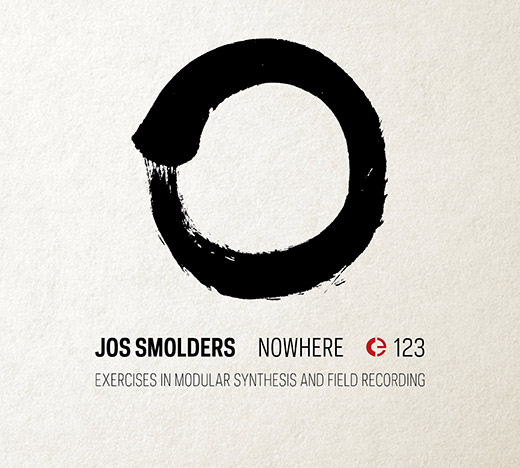
“Nowhere: Exercises in Modular Synthesis and Field Recording” reviewed by Blow Up


Dopo trent’anni di pratica compositiva — a partire da THU20 sino alla pura ricerca sulle componenti struturalli del suono — passando attraverso varie esperienze a margine da co-editore di Vital Magazine e da fondatore della piattaforma web EARlabs.org, Jos Smolders negli ultimi anni ha applicato alla propria produzione artistica le pratiche Zen a cui si è gradatamente avvicinato nel tempo, cercando quindi di trovare il punto di equilibrio tra pensiero, gesto e sendo dell’esistenza. Le sei composizioni contenute in “Nowhere” sono giustapunto il frutto di questo approccio instintivo e spirituale alla creazione, pagine in cui alla sintesi modulare viene applicata la stessa stilizzata destualità con cui l’autore traccia gli ideogrammi rappresentati sulla copertina dell’album. Quasi si tratasse di riproporre la stessa meticolosità del calligrafo in un contesto del tutto diverso rispetto a quello della scrittura, Smolders procede per variazioni minime condensando in una serie di frammenti di materia elettronica la sua idea di volersi esprimere più attraverso la sottrazione che l’affermazione di sé. L’insieme trasmette quindi un’impressione di forte omogeneità ma talvolta risulta sin troppo radicale nella sua forma estremamente sintetica e controllata. (6/7) Massimiliano Busti