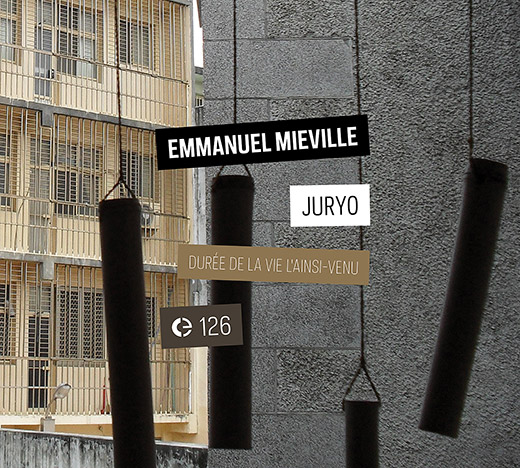
Badet man da in Mondlicht? Strudelt man da im Ocean of Sound? Der GRM-studierte Pariser taucht einen in eine metalloide Liquidität, die er, angeregt durch Artauds “Héliogabaleâ€, ‘Tanit Asterté’ nannte. Es ist das ein initiierendes Eintauchen, dem ein fernöstlicher Triptychon folgt: ‘Nyorai’ (eine des Inkarnationen Buddhas) – ‘Musaraki’ (japanisch für Purpur) – ‘Taisi Funeral’ (Taisi heißt Botschafter, Gesandter). Der geprägt wird von singenden tibetanischen Nonnen, Klosterglöckchen und Radiostimmen aus Hongkong, von Japansounds und Butohtänzern und zuletzt buddhistischem Trauergesang von Frauen in einem Dorf in Taiwan, der mit klackendem Beat immer mehr beschleunigt und dem Toten wohl Beine ins Jenseits macht. All das als Nudeln und Gemüse in einer nach konkretem Usus gekochten Suppe, die einen mit jedem Löffel asiatische Essenz schlürfen lässt, als Souvenirs mit Yogawikiakzent, verweht und verwischt wie von Wind und Regen, verdünnt und verschiffen in einem Frequenzbereich der Erinnerungen und der Projektionen. Mit geisterhaften Anmutungen von Gesängen, verbittert, bebend, zuckend, wie unter Wasser gehört, brodelnde, sausende, ondulierte Feldaufnahmen, turbulent verwilbelt, verdichtet und ausgepresst als der poetische Saft einer Blutente. ‘Taisi Funeral’ bekommt sogar einen dröhnenden Death Metal-Drive. Zum eponymosen ‘Nyoirai Juryo Hon’-Kapitel der “Lotus Sutraâ€, das die äugen öffnet, käme das als “Effata†der Ohren hinzu.
“The Waste Land†reviewed by Chain DLK

The title track of “The Waste Land†is an unusual example of soundwalking- strolling about gathering atmospheric found sounds and ambiences. While the process often leads to broad and relaxing soundscapes, this is a willful inversion, heavily processed, twisted and alienating. Strong gusty winds and heavy industrial noises of unknown origins lead to a scene that’s almost post-apocalyptic in its atmosphere. At times it sounds insular, almost claustrophobic, with noises akin to deep breathing noises recorded from underneath a coat. Over the fifteen minutes of the title track the sounds evolve fairly rapidly- at points there’s just a single layer, then before too long there are four or five competing noises.
“Voices From The Coal Mine†is an exploration of reverberation in a gigantic enclosed space- sporadic metal hits and scrapes fade into the distance with incredibly long echo tails which begin to layer and form their own, wall-and-material-born hum.
“My Extra Personal Space†is initially a slightly more typical and familar soundwalk- village sounds of gates, passing cars, church bells and birdsong- but as it progresses, further metallic hums and tubular resonance begins to cut through, as though something very sinister is afoot in the previously peaceful town. It all gets a bit “Village Of The Damned†in soundscape form. As it evolves further we move from Normandy to Paris, with more urban noises, metro announcements and suchlike, as though we’ve travelled more in time than in space.
“The Waste Land†is an unusual hybrid of found sounds and treatments, infused with a lot of energy. It covers a lot of ground in 37 minutes and is certainly an interesting, if not always comfortable, journey. Stuart Bruce
via Chain DLK
“The Waste Land†reviewed by Words & Guitars

An intriguing download and limited edition cassette release from a new Portuguese label Crónica, documenting the work of researcher and artist Luca Forcucci. Forcucci’s website cites his intellectual debt to Pauline Oliveros’ concept of ‘deep listening’: the ability to appreciate and perceive an environment then offer a sonic (or other) response. The results in this case are a testament to what can be wrought from this approach and will jolt the heart of anyone who appreciates dark ambient, Ben Frost’s more raw output, industrial’s less beat-driven sonic explorers, or horror soundtracks.
There are three decisively different experiences here. The title track is a glowering abyss in which metal shears, shimmers and tingles while more granular sensations split the surrounding vacuum. There’s not necessarily a visible progression, it’s more an evolving storyline rather than a cyclical experience. It developed from Forcucci being provided with an anonymous six minute sound recording and an invitation to create a soundtrack to an (unnamed) documentary. Whatever those original pieces consisted of, Forcucci’s response sounds akin to being on the launch pad under a NASA rocket: a cascade of sparking violence.
‘Voices From The Coal Mine’ involved sounds being projected into the power plant of an abandoned coal mine – a space that responds with a breadth of resonances and sudden shocks. It’s a well-chosen location laced with ideas of human use and abandonment, of less than sympathetic interaction between man and earth. The twittering of birds re-inhabiting our leftovers occasionally enters around the percussive core.
‘My Extra Personal Space’, uses the results of walking in both urban environments and the countryside to layer up an intriguing composition in which removing the divide between each space creates a disturbing whole. It’s a walk in the uncanny, the places that are not quite one nor the other. The crack of pebbles underfoot, the chatter of gulls – pressed tight against a bell chiming as if for invasion; the creak and grind of road traffic; the Paris metro. It’s a constant hubbub undercutting the imagined idea of countryside in which nature quietly wheels in peaceable patterns and man is becalmed. At one point a gull comes so close it sounds like an assault, a forlorn fight back against this encroachment. Nick Soulsby
via Words & Guitars
“Digital Junkies in Strange Times†reviewed by Chain DLK

Delving deep into the laptop, “Digital Junkies In Strange Times†is a genre-ignoring collection of electronic ambiences that draws ethereal samples shamelessly from any source that appeals. Most prominently this is R&B acapellas (some re-recorded presumably for legal reasons), processed to drift in out of our consciousness like a distant radio broadcast, but other found sounds are thrown in too. Under this, the core of this album is a gentle electronic soundscape which is soft yet glitchy.
“Turbulent Sphereâ€, at 13 minutes, is a relatively steady piece with a digital heartbeat. Processed bell sounds and warm chords ebb above. The beginning and end of the piece are weirder than the middle; twisted attempts at key changes towards the end sound playful or positively tongue-in-cheek at parts.
At only a minute and a half long, “Acousmatis†is a wonky processed acoustic guitar loop that seems to be present for two reasons, firstly because it’s a little silly, secondly to increase the track count. The other short track “Teen Haze†is more worthwhile, an almost radio-edit-y bit of anti-pop instrumental with deep flangey bass notes and a lightweight, crisp laptop-hip-hop beat, degenerating into metallic creaks as it develops.
The main meal of the release is the 41-minute “Moonlight Compilationsâ€, which walks a fine line between being a single electronic work and a mix album. There are some steady tempos and recurring elements throughout. Sometimes there’s several layers in play, sometimes there’s a pure single element standing alone. At points it drops to nothing more than distant birdsong, reminiscent of The KLF’s “Chill Outâ€, with which it shares a sense of live, improvised fader-riding. At other points, it’s a heavier electronic throb, with a womb-like ambience, sometimes pale hisses and windy tones. The on-and-off languid female vocals are a little Leftfield-y. It evolves slowly and it’s generally melancholic, but the electronic pulses are prominent enough that you’re rarely allowed to proper relax in listening to it. Though it’s never out-and-out silly, things do get more wig-out at the end with the brass sounds of some bizarre Latin-sounding TV theme and some random plucked harpsichord notes.
Arguably “Moonlight Compilations†is a little self-indulgent and is a little longer than is warranted, but as an improvised bit of electronic soundscape, there’s a lush, rich feel to most of it that makes it an enjoyable listen. Stuart Bruce
via Chain DLK
New release: Luca Forcucci’s “The Waste Landâ€
Realities, appearing as multiple layers and folds in which memories, cognitions, perceptions are coined and ready to emerge.
The starting point for The Waste Land was an invitation to compose a twenty minutes soundtrack for a documentary movie. Accordingly, Luca Forcucci received six minutes of a field recording, without any mention of its own nature, or any information about the documentary. Forcucci didn’t ask anything about it, instead he listened carefully to the sonic material until images started to appear. The more he listened the more clear images emerged from his own mental movie.
The resonances emerge from the multiple projections of sounds into the power plant of an abandoned coal mine within a process that progressively recombines sound. Voices from the Coal Mine is freely inspired by Alvin Lucier’s I Am Sitting in a Room. Real spaces act as resonant filters and lead to virtual spaces made of resonances. Metaphorically, it encapsulates the memory of the voices and activity of the former workers from the coal mine.
My Extra Personal Space explores convergences of timbres from antagonist soundscapes of nature from the Normandy coast and urban contexts from Paris. Soundwalking is a component and tool to investigate, listen to and compose with the environment. This piece pays a tribute to urban drift of the Baudelairean flâneur — the casual wanderer, reporter and observer in the city.
All music by Luca Forcucci. Composed and mixed at INA GRM (Paris), Electronic Music Studio TU (Berlin), Atomic Lady (Earth). Mastered by Taylor Deupree. Cover photo by Luca Forcucci.
“The Waste Land†is available as a limited edition tape or a download.
Futurónica 189

Episode 189 of Futurónica, a broadcast in Rádio Manobras (91.5 MHz in Porto, 18h30) and Rádio Zero (21h GMT, repeating on Tuesday at 01h) airs tomorrow, March 31st.
The playlist of Futurónica 188 is:
- Kontakt der Jünglinge, 1 (2001, Kontakt der Jünglinge 1, Die Stadt)
- Kontakt der Jünglinge, 0 (2001, Kontakt der Jünglinge 0, Die Stadt)
You can follow Rádio Zero’s broadcasts at radiozero.pt/ouvir and Rádio Manobras at radiomanobras.pt.
Soon in Crónica: Durán Vázquez’s “Hiku Komuro, Hikikomoriâ€
“Digital Junkies in Strange Times†reviewed by Data.-Wave

The brand-new Ran Slavin’s album, which was just released on the label Crónica, sounded incredibly awesome in my media player. I’ve always been interested in his music, but I was surprised to discover that Digital Junkies in Strange Times was even more intriguing than his previous work. Not long ago, Data.Wave hosted an interview with Ran Slavin that really highlighted aspects of his talent as a video-audio designer, but a lot was left out. Listening to Digital Junkies in Strange Times convinced me one again, that there are no limits to a real artist’s creativity.
The art of a real musician always surpasses all standards and clichés, and this album is a confirmation of this truth. Ran Slavin never repeats himself; his every release is unlike the previous ones; he develops and implements new paths for his sound. The digital LP Digital Junkies in Strange Times begins with quite a dynamic track Turbulent Sphere, where a stream of clicks speeds up and gradually merges into an R’n’B vocal that sounds like a complete fullout. At the same time you can hear space-like sounds, appearing and disappearing noises, hits. I can’t say for sure, but maybe it’s someone repairing a space zen-station, floating on the orbit…
I’ve never heard anything like this and I can’t compare Digital Junkies in Strange Times to anything else, but I would dare to guess that a live show with a set like this would knock people over and turn their minds upside down.
Ran Slavin’s method of shaping the sound is very subtle, it walks the thin line of the limits of our perception, but his music doesn’t quite cross this border.
The second track, Acousmatis, and its guitar sounds really invoked memories of the Moebius comic books, like a time-out from the inside of an illusive digital city. It’s sad that it’s such a short track, because I would gladly listen
to more of this. The thing that begins from the third track, Teen Haze, really switches the mood and gets us ready for the very impactful fourth track Moonlight Compilations, that is actually a bit more than just a track; it’s a recorded live improvisation on the radio Halas, the overall duration of which is 41:34.
Moonlight Compilations is a volatile mix, an incredible clash of genres that transports us to another dimension.
It has an incredible amount of various instruments, futuristic structures, field recordings, creating a real digital Metropolis, our natural habitat. It’s difficult to describe all this just with text, because this intellectual experiment invokes very strong interior emotions and feelings. Anyone can listen to this release now as the album Digital Junkies in Strange Times is available for free download, so why not get it while you still can!
via Data.Wave
“Juryo: Durée de la vie de l’ainsi-venu†reviewed by Gonzo Circus

De Franse componist Emmanuel Mieville studeerde geluidstechniek bij een filmopleiding en musique concrète bij de beroemde Groupe de Recherches Musicales (GRM). Verder verdiepte hij zich in noet-Westerse instrumenten en speelde hij in een (Frans) gamelan-orkest. Die verschillende leerscholen klonken door in zijn uitgaven die in de afgelopen ruime tien jaar her en der verschenen. Bijvoorbeeld op de twee volwaardige en goede albums die Baskaru uitbracht en wederom op de nieuweling ‘Juryo’ die nu bij het Portugese Crónica is verschenen. Het album heeft de ruimtelijkheid van het album ‘Ethers’, de exotische field recordings van datzelfde album en van ‘Four Wanderings in Tropical Lands’, een – ondanks de abstracte composities – haast verhalende kwaliteit en een grote helderheid van klanken van melodie- en ritmeloze composities. Het palet aan geluiden klinkt meestal bekend en doet denken aan veel elektronische en elektroakoestissche muziek – het album zou ook passen in de caatlogus van Empreintes Digitales, bijvoorbeeld. De lijn in de composities is niet altjid duidelijk; ruime delen van de vier lange composities klinken als een veelheid van opeenvolgende ideeën of een collage van ‘klakvignetten’. Gebrek aan richting breekt een compositie van bijna achttien minuten op, de spanningsbood verslapt. Daar staat tegenover, de afwisseling en combinatie van bijvoorbeeld lange hoge en korte tonen, borrelende geluiden, elektronisch gesputter en gespetter, tinkelende en ruisende elektronica, organisch, hecht en sfeervol is. Verrassend en geslaad is vooral de verwqerking van niet of nauwelijks bewerkte field recordings in de abstracte elektronische composities. ‘Nyorai’ bevat zang van Tibetaanse nonnen en radiofragmenten uit Hong Kong; in ‘Taisi Funeral’ zijn opnamen van repetitef Boeddhistisch gezang voor een dode in Taiwain opgenomen. Zo valt het eindoordeel over het album alsnog positief uit. (rm)
Via Gonzo Circus
“Geography†reviewed by HIS Voice

Do katalogu portugalského labelu Crónica pÅ™ibylo po deseti letech nové dÃlo Vitora Joaquima, laptopisty, výtvarnÃka a online aktivisty, od osmdesátých let jednoho z nejvýraznÄ›jÅ¡Ãch pÅ™edstavitelů portugalské elektronické scény.
Nové CD nese název Geography a je inspirováno myÅ¡lenkami amerického vÄ›dce, fyziologa a geografa Jareda Diamonda, zejména jeho dÃlem Osudy lidských spoleÄnostà (Guns, Germs, and Steel: The Fates of Human Societies, 1995; Äesky Columbus, 2000), které si klade otázku, co způsobilo, že se od urÄitého bodu zaÄaly různé lidské spoleÄnosti vyvÃjet různÄ› a nikoliv stejnÄ›? Diamondovou odpovÄ›dà je, že na vinÄ› jsou různá prostÅ™edà – tedy zemÄ›pis – nikoliv biologické odliÅ¡nosti mezi jednotlivými lidskými skupinami.
Tolik nutné hudebnÄ›-publicistické minimum, které v JoaquimovÄ› pÅ™ÃpadÄ› rád opustÃm. V prvnà řadÄ› proto, že umÄ›lcovu mikroesej na toto téma si lze pÅ™eÄÃst pouze v tiskové zprávÄ›, nikoliv na obalu CD samotného, kde je zmÃnÄ›na jen inspirace Diamondem a žádné rozklady na toto téma se nevedou (na crónicovském bandcampu ale zase ano), pÅ™edevÅ¡Ãm ale proto, že Joaquim je hudebnÃkem s natolik výrazným autorsko/improvizaÄnÃm rukopisem, že se rád nechám okouzlovat sluchovými vjemy, nikoliv brilantnÃm zámÄ›rem. Sám ostatnÄ›, podobnÄ› jako napÅ™Ãklad Francisco López, rád hraje potmÄ›, aby posluchaÄi byli opravdu posluchaÄi.
ZemÄ›pis v názvu alba se ovÅ¡em dá chápat i jako poklona jedenácti z hudebnÃků, s nimiž Joaquim – dle vlastnÃch preferencà spÃÅ¡ sólista – v minulosti mÄ›l tu Äest na pódiu; na novince záznamy spoleÄného hranà sampluje, takže se můžeme nechat pÅ™ekvapovat hlasy harfy, houslÃ, klavÃru, dechů, perkusà Äi akordeonu… a kromÄ› toho i samply z nÄ›kolika Joaquimových starÅ¡Ãch alb. Ty na novince najÃt neumÃm, u zvuků akustických nástrojů mÄ› ale těšÃ, jak organicky jsou vetkány do anorganického svÄ›ta jedniÄek a nul. Žádné duely, nýbrž plynulá pÅ™elévánà rovnocenných hlasů. Trochu nadbyteÄnÄ› působà jen sampl zkresleného hlasu v úvodnÃm tracku. Prý jde o záznam z programu Apollo, tedy symbolický pohled na pozemskou geografii z vesmÃrné výše, podobnà „rozhlasovà hlasatelé“ jsou ale dosti omÅ¡elou rekvizitou.
Poslouchat laptopistu, kterak kliká, katuje a glitchuje, v tom už je pro mÄ› sakramentská dávka nostalgie. Leckdo laptopy, které byly pÅ™ed cca patnácti lety div ne stavÄ›ny na piedestal, nynà bere jako samozÅ™ejmost, nutné zlo nebo je rovnou opustil pro hranà „živÄ›jšÓ, „analogovÄ›jšÓ, „kontaktnÄ›jšÓ. Z noÅ¥asů se stala tak samozÅ™ejmá souÄást domácnostà a pracovišť, že nás svou novostà a nedostupnostà už nedojmou. (Kolik laptopů byste si koupili za penÃze na pořádný modulárnà synťák?) Zrovna tak hudba, kterou jsme si zvykli spojovat s termÃny uvedenými v prvnÃm řádku tohoto odstavce, už má dávno setÅ™ený pel.
Vitor Joaquim ovÅ¡em s pÅ™ehledem ukazuje, že živá digitálnà hra na pomezà kompozice a improvizace je dodnes platnou disciplÃnou a dá se dÄ›lat s virtuozitou, jejÞ samozÅ™ejmou souÄástà je nezastupitelnost nástroje. Netroufám si odhadnout, do jaké mÃry se zde živÄ› improvizuje, do jaké komponuje, do jaké stÅ™Ãhajà nahrávky vzniklé v různých kontextech (i geografických). PatrnÄ› od každého nÄ›co, výsledek je ale nezpochybnitelnÄ› joaquimovský.
Osmero tracků se honosà pÅ™Ãkladnou digitálnà Äistotou, pÅ™itom ale působà jako ideálnà hudba pro podzimnà poslech pÅ™i svÃÄce. Každá vrstva zvuku nese výrazný melodický Äi rytmicko-repetitivnà motiv (nebo jeho náznak), vždy ve stÅ™ednÃm až pomalém tempu. VÅ¡echny hlasy se pÅ™irozenÄ› pÅ™elévajÃ, doplňujà a stÅ™ÃdajÃ, žádný nápad nenà strojovÄ› opakován. Improvizace, softwarové a stÅ™ihaÄské fÃgle – a výsledek je uklidňujÃcÃm způsobem skoropÃsňový. StaÄilo by jen tu a tam neuhnout a mÃsto dalšà pozvolné odboÄky nÄ›co zapÄ›t… ale proÄ, že ano? Takhle je to podmanivÄ›jÅ¡Ã. Petr Ferenc
via HIS Voice