Futurónica 173

futurónica_173
Episode 173 of Futurónica, a broadcast in Rádio Manobras (91.5 MHz in Porto, 18h30) and Rádio Zero (21h GMT, repeating on Tuesday at 01h) airs tomorrow, August 19th.

The playlist of Futurónica 173 is:

  1. Enrico Coniglio, Astrùra (Parts 1 & 2) (2016, Astrùra, 13(3))
  2. Enrico Coniglio, Solèra (Parts 1 & 2) (2016, Solèra, 13(3))
  3. Lemures, VI (2013, Lemuria, Crónica)
  4. Lemures, I (2013, Lemuria, Crónica)
  5. Lemures, II (2013, Lemuria, Crónica)

You can follow Rádio Zero’s broadcasts at radiozero.pt/ouvir and Rádio Manobras at radiomanobras.pt.

“Geography” reviewed by Nitestylez.de

cronica117-2016_520
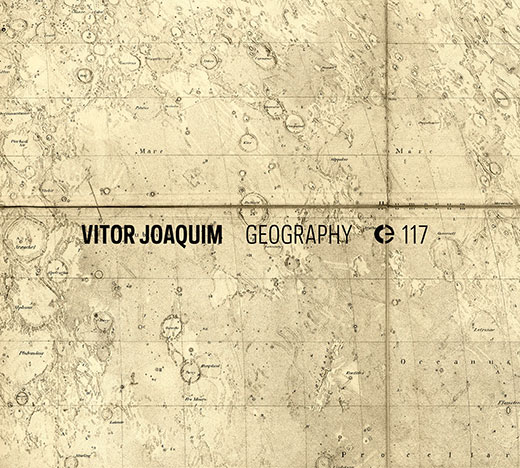
The Portuguese imprint Crónica has become kind of a staple when it comes to releases being reviewed on these pages on a regular and that’s why we are looking forward to embrace Vitor Joaquim’s upcoming album “Geography” that’s scheduled for release on September 13th, 2k16. Vaguely dealing with the concept of how the planets geography has shaped the development of mankind as a whole throughout its entirety the album opening title track embeds fragments of space documentaries in an environment both shaped by organic sounds and glitches falling together in a warm and welcoming, yet also alien way – once again a feel that takes us back to our deeply loved copy of Oval’s “Systemisch” album in a way we’re sure that we’re not the only ones using this classic as a reference. The second cut, “Cantino”, starts with piercing digital, heavily disturbed signals that are accompanied by strange chirps, static crackle and other weird interferences, “Ganda” deals with a fusion of cold and sterile mechanic repetitions with additional layers of distorted, blurred Indietronic transmissions from an FM radio station located thousands of miles away and the pulsing, spiralling nature of “Technography” is facing some deep, organic melancholia along the way. With “Cargo” we’re taken on a calm and relaxing journey provided by slow, yet steady Ambient movements and a crackly, continuous hiss evoking memories of soft, steady rain on vintage autumn afternoons whilst obscured fragments of Alien FreeJazz performances are present somewhere in the background before “Exodus” explores quite minimalistic terrain and provides both an eerie, slightly threatening as well as a quite natural, ritualistic feel due its abuse of heavily and warped vocal bits by Nino De Elche which are taken from a live performance with Vitor Joaquim like many other fragments of the album were originally recorded on stage with artists like Harald Sack Ziegler, Gustavo Costa and many more. In “Domo Arigato” more warm, crackly Ambient layers and crystalline glockenspiel sequences make us feel at home in any second of the track that’s building up to intense density slowly, providing sampled percussion bits strangely sounding like hydraulic air pops of some kind whilst the concluding 109 seconds of “8’20″” are basically a sequel / part II of the previous tune as their transition is seamless, bringing in processed bits of a Laurie Anderson interview as additional sonic element instead of morphing into a completely new tune. An interesting concept for a closing bit indeed, yet a well fitting finish to this recommended long play piece.

via Nitestylez.de

“Geography” will be published September 13 and is now available on preorder on cronica.bandcamp.com

@c’s “LMY-7-10”

LMY-7-10 from Miguel Carvalhais on Vimeo.

Pedro Tudela and Miguel Carvalhais’s installation at this year Serralves em Festa, in Porto, is finally documented in a short video. If you didn’t make it there, get your headphones and enjoy the sample. More photos are available at at-c.org.

Tudela and Carvalhais are currently working on a new piece, to be premiered September 1st at Lisboa Soa!

“Prevailing Wind, Tangled Under” reviewed by Ambient Blog

cronica114-2016_520
For those interested in environmental recordings, the Corollaries series on the Crónica label is a definite must-check.
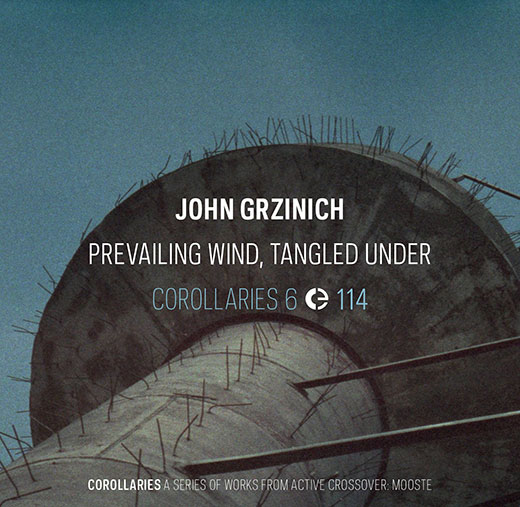
This (sixth) edition in the series is an acoustic exploration of a deserted, metal water tower about four stories high made by soundscape artist John Grzinich.

“People are pulled inward upon hearing the depth of the reverberations from within. In numerous instances time seemed to stop as we gathered around, crawling about, climbing, plucking, bowing, striking, howling, stringing and generally playing in and around the great structure.”

Two single-take recordings were made: “the first was a dialogue of sorts between three artists carried out through sporadic sounds and the second was a solo follow-up to meditate on how the various artifacts attached in the previous months were affected by the windy conditions”.

The metallic sounds – clangs, whistles, whispers and moaning – from within the tower suggest that it’s alive and breathing.
A fascinating recording of post-industrial environmental ambience, available as a Name Your Price download (as are all editions in this series). Peter van Cooten

via Ambient Blog

Futurónica 172

futurónica_172
Episode 172 of Futurónica, a broadcast in Rádio Manobras (91.5 MHz in Porto, 18h30) and Rádio Zero (21h GMT, repeating on Tuesday at 01h) airs tomorrow, August 5th.

The playlist of Futurónica 172 is:

  1. France Jobin and Stephan Mathieu, The Answer IV (2016, Radiance II: Music for the Answer, Schwebung)
  2. France Jobin and Stephan Mathieu, Sea Song I (2016, Radiance II: Music for the Answer, Schwebung)
  3. France Jobin and Stephan Mathieu, The Answer V (2016, Radiance II: Music for the Answer, Schwebung)
  4. France Jobin and Stephan Mathieu, Sea Song IV (2016, Radiance II: Music for the Answer, Schwebung)
  5. France Jobin and Stephan Mathieu, The Answer I (2016, Radiance II: Music for the Answer, Schwebung)
  6. France Jobin and Stephan Mathieu, Sea Song V (2016, Radiance II: Music for the Answer, Schwebung)
  7. France Jobin and Stephan Mathieu, The Answer VII (2016, Radiance II: Music for the Answer, Schwebung)

You can follow Rádio Zero’s broadcasts at radiozero.pt/ouvir and Rádio Manobras at radiomanobras.pt.

“Throttle and Calibration” reviewed by Touching Extremes

cronica115-2016_520
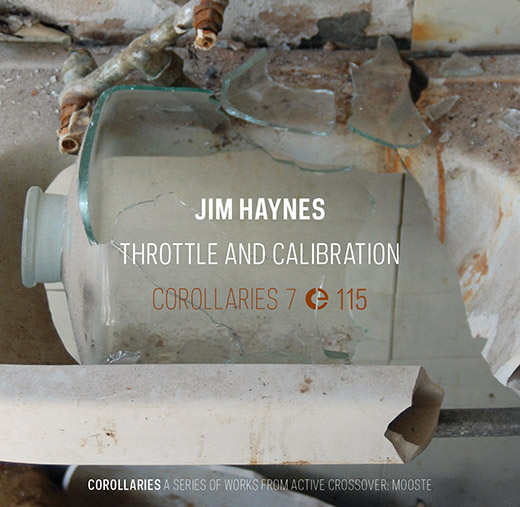
Jim Haynes produces sulphureous visions from a peculiar brand of ill-defined concreteness; any hint to humanitarianism is canceled as states of feverish awareness announce terrible things to come. Throttle And Calibration may be born from the processing of hybrid recordings by different collaborators, yet it exudes the toxicity typical of the man’s finest outings. In a difficult field like this, it takes a special talent to maintain a high level of quality over the course of a lengthy career. In that regard, Haynes rarely fails to deliver the goods.

The five tracks walk convolute paths across variously altered matters and psychological conditions dictated by a thorough annihilation of “positive vibes”, as they say in the trade. When the relentless power of ineluctable events overwhelms the mind in all possible ways – from an obliteration of the mere act of thinking to the suggestion of utter hopelessness – that’s an unequivocal sign of success inside and beyond the compositional mechanism. Efficaciously harsh signals carve deep scars in the systems of acoustic receptiveness. Disembodied voices act as mini-preambles to landscapes of desolation contoured by an unspeakable anguish. Violent echoes of mechanical guerrilla wake us up while attempting self-hypnosis within the sonic grain. Slowly sloping drones and deceivingly calmer textures initiate the listener to the cult of a future that’s not going to greet us with a warm smile.

Live with this music for a while and start decoding its concealed messages minute by minute, notwithstanding the lack of luminousness. Remain in search of a sense of harmony that is actually there, only dressed in putrid rags and immobilized by musty ropes. Electrical shocks to desperately revive an already dead humanity; the unique grace of decay emerging from unusually amassed frequencies. It’s classic Haynes, and we need it. Massimo Ricci

via Touching Extremes

New in the Corollaries series: Jim Haynes’s “Throttle and Calibration”

cronica115-2016_520
“Throttle and Calibration” is the seventh release in the series Corollaries, that compiles works resulting from Active Crossover: Mooste, a cross-cultural collaborative residency curated by Simon Whetham and hosted by MoKS, in April and May 2015. All works are composed from material compiled in a collective archive during the project.

All source material in “Throttle and Calibration” collected from the Active Crossover archives, with recordings and sounds by Tuulikki Bartosik, Richard Eigner, John Grzinich, Jim Haynes, Rostislav Rekuta, Yiorgis Sakellariou, Dawn Scarfe, Eamon Sprod, Taavi Suisal, Simon Whetham, and James Wyness, 2015.

Noise, immolation, heterodyning, and other signal manipulations conducted by Jim Haynes at Helen Scarsdale’s shipping container in 2016.

“Throttle and Calibration” is a free download from Crónica or Bandcamp.

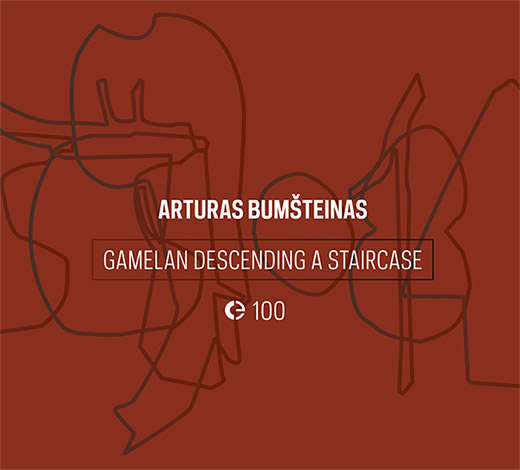
“Gamelan Descending a Staircase” reviewed by Nieuwe Noten

Gamelan Descending a Staircase
Met ‘Gamelan Descending a Staircase’ leidt de Litouwse componist en elektronica producer Arturas Bumšteinas ons binnen in de wereld van de gamelan. Het Indonesische slagwerk orkest. Het stuk, op de gelijknamige CD is wel op een heel bijzondere manier ontstaan.

Bumšteinas maakte in 2013, samen met Raminta Atnimar opnames van de diverse onderdelen van het gamelan orkest in het etnologisch museum van Berlijn. In 2015 bewerkte Bumšteinas deze geluiden vervolgens tot de huidige compositie die in april 2015 tijdens het Jauna Muzika Festival in Vilnius, Litouwen in première ging.

De titel ontleende Bumšteinas aan een schilderij van Marcel Duchamp, ‘Nude Descending a Staircase, nr.2′. Bumšteinas toont in deze compositie bijzonder geïnteresseerd te zijn in de enorme klankrijkdom van het gamelan orkest. Een duidelijke structuur ontbreekt, evenals een eenduidige richting. Sommige passages kennen wel iets van een ritme, maar verreweg het grootste deel van het stuk is te omschrijven als een dwaaltocht. Maar aangelengd met de nodige noise en distorsion is het wel een spannende dwaaltocht geworden. Maar die analogie met het doek van Duchamp is dus zo zo gek nog niet. Bumšteinas zegt daar zelf over: “Marcel Duchamp’s 1912 painting Nude Descending the Staircase. No.2 was an inspiration lurking not only behind the title of this composition but also regarding the deconstructed micro-forms and the study of sound structures, progressing as if in slowmotion, and without a clear point of destination… Descending into the unknown territories… The title came in a vision, as a possible sonic event of a instruments of a gamelan orchestra falling down the stairs. A beautiful, unrealistic image. A dream.”

Ook het tweede stuk op het album, ‘Sad Young Man on a Train’ is te beschrijven als een studie naar klank. Hier ligt de basis bij het clavecimbel. Maar denk hierbij dan niet aan de heer Bach en zijn tijdgenoten. In dit stuk klinkt het geluid van dit instrument totaal anders. Dankzij een uitgebreid scala aan hulpmiddelen, tot aan een cappuccino mixer aan toe, slaagt Bumšteinas erin om ook hier een zeer interessant klankuniversum te creëren. Ben Taffijn

via Nieuwe Noten

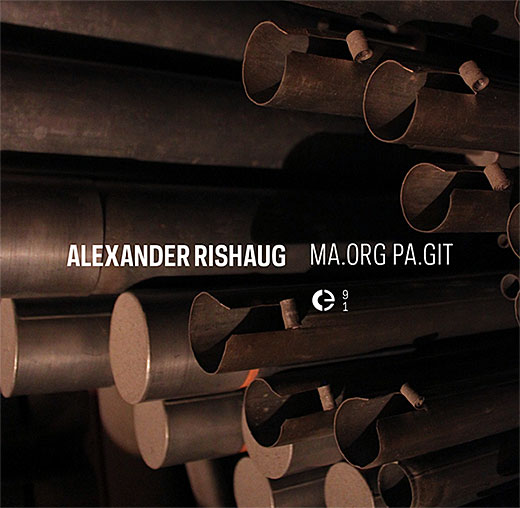
“Ma·Org Pa·Git” reviewed by Revue & Corrigée

cronica091-2015_520
Deux pièces, enregistrées à Rotterdam dans l’église des marins norvégiens en 2012, utilisant orgue, guitare em ampli vox. La première, “Ma.Org”, comme son nom l’indique, est une pièce d’orgue, entrons segments. Tout d’abord un continuum, en un long déroulement, jusque’à la moitié. Puis dans la seconde section, des sons de soufflerie, comme des flûtes basses, et lentes, créent une respiration, qui enfle et prend son rythme de croisière, entrecoupée de sons concrets (bois, pédales). Un nouveau continuum compose la dernière section, très ambiant et mélodique, virant progressivement au répétitif, un peu à la Terry Riley, allant en s’étoffant. Le second morceau, “Pa-Git”, est une pièce de guitare, qui démarre sur le son voilé et un peu distant d’une boucle de saturation grise, tournant comme un ventilateur. Une basse lancinante, qui découpe le temps, vient se poser, tandis qu’une mélodie d’orgue se joue en arrière-plan, façon Soft Machine rencontrant Ash Ra Tempel. S’y ajoutent des résonances, et la trame s’épaissit, déroulant son tapis, relayée et doublée d’une guitare très krautrock qui s’achève dans des souffles gris. Un album court, de moins de 33 minutes, qui développe deux pièces au caractère plutôt enveloppant et mélodique, distillant une présence concrète, dans les souffles résiduels de tuyaux, de très légers à très présents, et tuant sur les contrastes entes des sons très nets et d’autres plus voilés et flous. Agréable. Emmanuel Carquille