
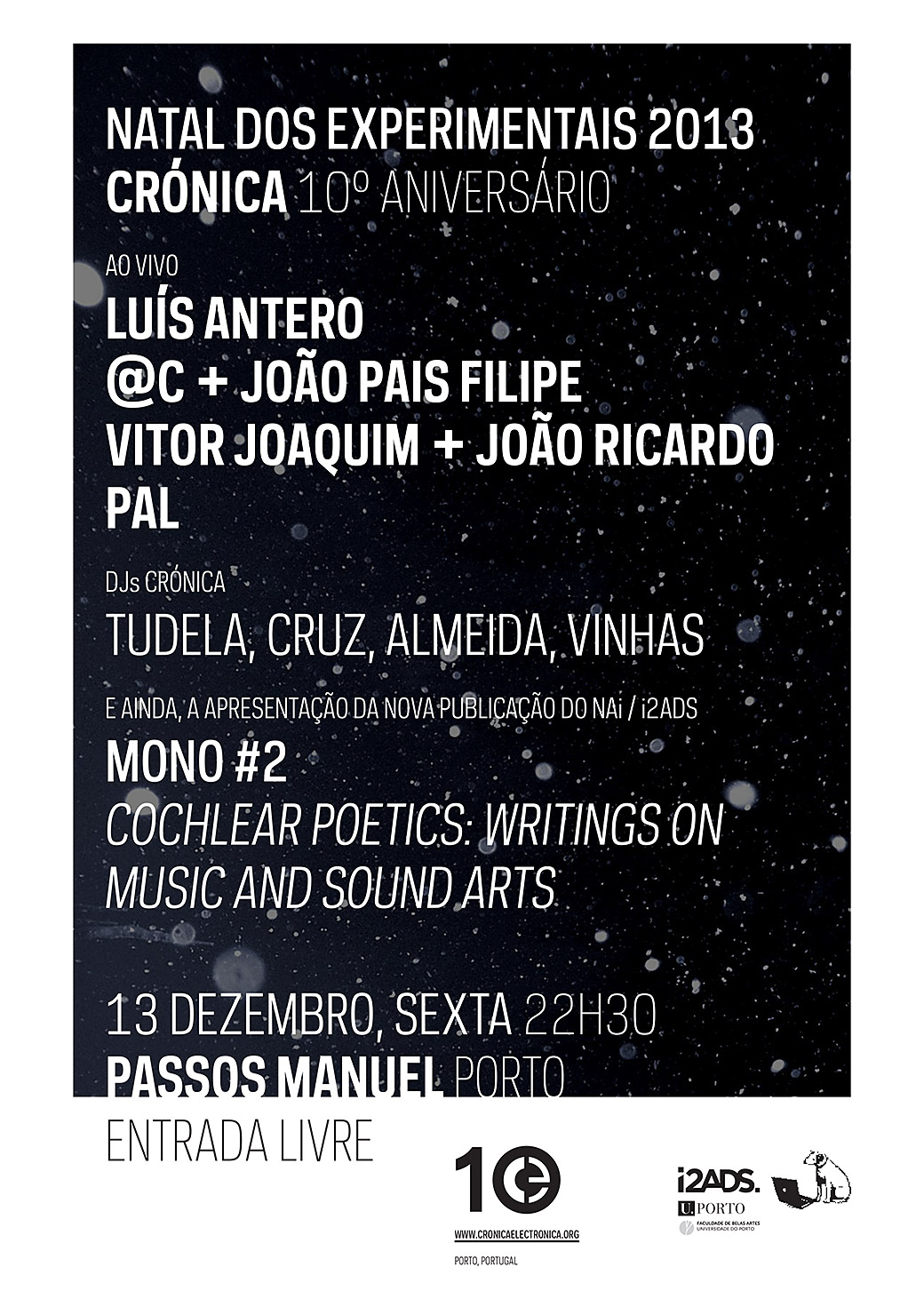
After Coimbra and Lisboa, Crónica celebrates its tenth anniversary in Porto with this year’s Natal dos Experimentais. As usual Passos Manuel will host a series of performances and Crónica’s DJs. This year’s program includes live sets from LuÃs Antero, @c + João Filipe (drums), Vitor Joaquim + João Ricardo and Pal. Kickstarting the evening we will present the latest publication of i2ADS, developed in collaboration with Crónica: Mono #2: Cochlear Poetics: Writings on Music and Sound Arts.
“Meubles†reviewed by Chain DLK

Although it’s quite rare that each instrument of Works’n’Days, a nice international ensemble of many improvisers – covering a wide range of instruments such as guitars, violins, saxophones, electric organs, flute, piano, cello, percussions and sampler -, which has been grouped together by young and inventive Lithuanian composer Arturas Bumsteinas, manages to conclude a musical phrase by itself before another musical voice bursts on the scene, they chorally succeeds in evoking hearth and home as if the whole furnishings and househols effects got turned into a resounding orchestra by some sorcery. Named after the didactic poem by ancient Greek poet Hesiod in the form of a farmer’s almanac, which is probably better known for some notorious stories about human condition such as the ones of Pandora and Prometheus, this debut release, which seems to quote Erik Satie’s furniture music (musique d’ameublement), tracks an original domestic arrangement down for a genre like improvisational music that some listeners erroneously keep on consider as an snobbishly intellectual enjoyment. Unlike Satie’s furniture music, as we cited it, or similar more or less theoretical models, the lukeworm long-lasting three suites of “Meubles” cannot be filed under background music as some instruments find the way to stand it out by sudden rashes or by pleasant phrases (or paraphrases) and this aspect is clear both in the initial “Hszcz”, where the parts of each instrument are more fragmentary, and in the following “Llull” and the alluring “David”, where some motifs sounds more vaguely agglutinating. You can try this at home!
via Chain DLK
“Blekâ€, a new game by Davor and Denis Mikan
“Blek†is a new game for iPad developed by Kunabi Brother, the team of Davor Mikan — that released Täuschung in Crónica — and his brother Denis.
Blek is about imagination, curiosity and experimenting. It’s about personality, your own style and temper. But most of all – it’s about PLAYING.
Blek is now available.
New release: “Concret-Sens†by Emmanuel Mieville
Crónica is very proud to present a new release from French composer Emmanuel Mieville, the wonderful “Concret-Sensâ€.
- Cillages (13:48)
- Locus Sonus (10:20)
- Solis Ortus (12:22)
The title of this release refers to a French adjective — concrescence — used by composer François Bayle to describe and underline in his music, the concrete substance of sounds, the quality of an object or sound to evoque the down to earth quality of its aural image (or its ruggedness, its wabi-sabi). It also plays on the specific meaning of sens, meaning direction. The direction towards concrete.
This was Emmanuel Mieville’s framework while composing these pieces, close to the essence of musique concrète, as defined by Pierre Schaeffer. He gathered found sounds and recordings, freely associating materials and sounds in a narrative approach, without transforming their intrinsic concrescence. Some elements were taken from radio archives, others were recorded but weren’t used in the final mixes, but still managed, however, to resonate throughout the pieces, such as the woman humming a melody and making coffee that was recorded for Locus Sonus.
Cillages uses recordings of neon lights and hums from electrical outlets. No other electronic devices were used.
Locus Sonus uses tape and field recordings as the main sources, accompanied by excerpts of radio documentaries and, in a sense, also working as a nod to Mieville’s approach to electroacoustic composition, learned first and foremost by listening to creative radio programs and live concerts. The magnetic presence of the tape is haunted by memories of sound, by anecdotes and personal historical elements.
The third and final piece, Solis Ortus, uses field recordings manipulated through granular synthesis, with dynamic and spatial treatments to create bursts of sound and semi-random movements in the stereo field.
“Concret-Sens†is now available through Crónica’s bandcamp page, Boomkat or iTunes.
Tomorrow: Crónica celebrates 10 years in Lisbon

Tomorrow night Crónica will be celebrating 10 years of ongoing activity with a double bill performance in Lisbon. Trem Azul will host performances by @c and Eosin and a DJ set by pedro Tudela.
“No End of Vinyl†reviewed by Liability

A la base de ce disque on trouve The End of Vinyl un ep de Pure sorti en 1999 sur Mego. Depuis, Cronica le propose en téléchargement libre sur son site. Quatorze années plus tard, Pure nous propose une relecture de ce disque faites par ses soins mais aussi par des artistes comme @C, Pita, Arturas Bumsteinas, Christoph de Babalon, Jorge Sanchez-Chiong, Opcion, Rashad Becker, Goner et Cindytalk. Rien que du beau monde. Mais, l’important dans ce genre d’exercice ce n’est pas de savoir qui fait quoi mais bien de constater si cela apporte vraiment quelque chose et si ces relectures dépassent les originaux. En tout cas, si on doit comparer les deux disques, il y a vraiment dans No End of Vinyl une volonté de reconstruction, de donner un souffle nouveau aux morceaux d’origine. Une chose est certaine. Les versions qui nous sont proposées ici ont moins cette connotation « drone » que ce qui pouvait y avoir dans The End of Vinyl. Les intervenants ont plus axé leur effort sur les différences rythmiques, les développements noises et les interférences sonores quand on ne passe pas carrément à des adaptations qui lorgnent vers l’électronica. Loin d’être inégal, l’ensemble n’est pas inintéressant. Bien au contraire, chacun ici fait plus que faire acte de présence. Le but n’était pas seulement, pour eux, de remixer bêtement les morceaux mais il s’agissait aussi d’insuffler dans chacune des versions une réflexion sur les « musiques digitales et le futur de ces médias ». Vaste question qui peut déboucher sur un nombre incalculable d’interprétation. Sur le site de Cronica on pourra voir le détail de conception de chacun des morceaux. On y verra alors que chaque artiste a une vision bien particulière sur la question. Pour autant, au-delà de savoir comment les morceaux ont été conçu, ces différences s’entendent aisément. C’est avec ce genre d’initiative que l’on peut dire que la musique électronique a encore de beaux jours devant elle, qu’elle a encore de nombreux défis à relever et qu’elle ne s’abandonne pas à la facilité qui a réussi à contaminer pas mal de cerveaux mal finis.
via Liability
Futurónica 102

Episode 102 of Futurónica, a broadcast in Rádio Manobras (91.5 MHz in Porto, 18h30) and Rádio Zero (21h GMT, repeating on Tuesday at 01h) airs tomorrow, November 29th.
The playlist of Futurónica 102 is:
- Bernard Parmegiani, Étude Élastique (1975, De Natura Sonorum)
- Bernard Parmegiani, Métamosphoses (1977, Dedans-Dehors)
- Bernard Parmegiani, Géologie Sonore (1975, De Natura Sonorum)
- Bernard Parmegiani, Incidences/Résonances (1975, De Natura Sonorum)
- Bernard Parmegiani, La Tables des Matières (1979, La Tables des Matières)
- Bernard Parmegiani, La Mémoire des Sons (2002, La Mémoire des Sons)
You can follow Rádio Zero’s broadcasts at radiozero.pt/ouvir and Rádio Manobras at radiomanobras.pt.
“Concret-Sens†reviewed by Essmaa

Emmanuel Mieville présente un concert de sons concrets, soundscapes, field recordings et objet amplifiés. La perception sonore est en effet stimulée par les espaces imaginaires du son, mais les outils informatiques pour jouer et composer sont si puissants qu’il devient nécessaire pour lui de ramener un ancrage d’objets et sons narratifs ou texturés visent la poétisation de l’espace musical scénique.
L’air frémit le temps de 3 compositions, le souffle d’Emmanuel Mieville est enfoui sous l’amas de frottement.. Pierre et silex raclent le métal et l’acier. La pluie flagelle et les ondes s’évaporent en stridence. Le résultat paraît le plus souvent hors du temps. Ces grincements semblent jaillir de mauvais rêves dans lesquels ils pourraient retourner aussi vite, perdus à jamais dans cette matière sonore.
via Essmaa
Soon in Crónica
MacDonald & Carvalhais at the London Jazz Festival

Next Friday, November 22nd, Raymond MacDonald and Miguel Carvalhais will perform a sax and laptop duo at the Club Inégales, in an event of the London Jazz Festival.
More information at London Jazz Festival and Club Inégales.