“No End of Vinyl” reviewed by African Paper

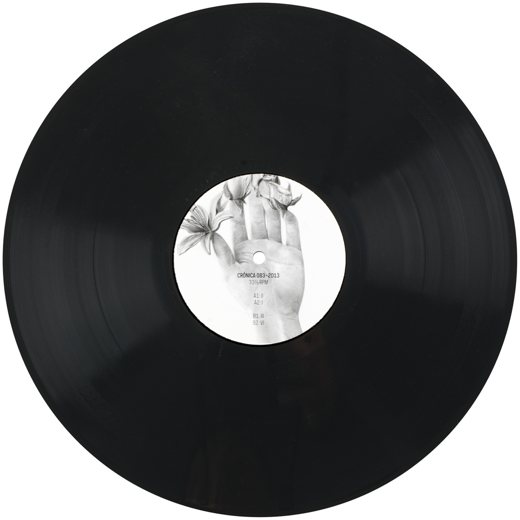
No End of Vinyl
Als Peter “Pure” Votava Ende des letzten Jahrhunderts mit dem Gebot brach “Du sollst dir kein Bild machen”, dass wahrscheinlich ebenso die Abwehr der zu billigen, der falschen Utopie ist, lieferte er dennoch mit “The End of Vinyl” ein gutes Drone-Album ab.

Das Ende von Vinyl – das schien Ende der 1990er als eine Art rationale Prophezeiung. Beobachtungen und Schlüsse, zu denen jeder Mensch (wenigstens potentiell) imstande ist, und die sich von denen eines “normalen” Menschen nur graduell unterscheiden, ließen vermuten, dass der Musikkonsum vollständig in die Immaterialität (ab)gleitet. Ein Medium wie Vinyl, dass aufbereitet wurde, um die Bedürfnisse und die Launen des (vermeintlichen) Musikliebhabers zu befriedigen, wies mehr als einen Fehler auf, aber schließlich ging bereits Strawinsky dazu über, die von ihm geleiteten Aufnahmen eigener Kompositionen zur verbindlichen Norm für jede Wiedergabe zu erklären. Er komponierte Stücke, deren Sätze gerade so lang gehalten sind, dass sie auf die Seite einer Grammophonplatte passten. Die Sorge des Musikers, sein Werk vor der Willkür des Ausübenden zu bewahren, erfuhr so eine vorher nicht mögliche Steigerung. Musik musste nicht länger in schriftliche Zeichen gepresst werden, sondern konnte als Klang seine Übermittlung finden. Eine Schallplatte ist nicht nur ein Grabstein, der musikalisch einen geschichtlichen Standort besetzt, von dem aus man die Deutung des Überlieferten vollzieht, sondern auch eine Art Spielstein, der für das Entwickeln neuer Klangwelten Verwendung findet. Das es sich dabei nicht einfach darum handelt, dass das was wirklich wird gegenüber dem als unendlich vorgestellten Möglichen vorweg etwas einschränkendes hat und sich so gleich um die Erfüllung der Wünsche bzw. den Inhalt der Wünsche betrogen sieht, spielt für die Mehrheit der Plattensammler eine nicht allzu große Rolle.

So konnte Pure seine Stücke zum Remixen freigeben und die äußeren Vorzeichen des Konzeptalbums in sein Gegenteil verkehren. “No End of Vinyl” geht sogar noch einen Schritt weiter und so erscheint diese Stücksammlung ausschließlich auf dem mittlerweile antiquierten Medium der Compact Disc.

Die Umsetzung der zehn Tacks ist allerdings durchwachsen. Während man bei der ersten Hälfte gut und gern Wilhelm Busch mit dem Ausspruch heranzitieren möchte: “Schön ist es auch anderswo. Hier bin ich sowieso”, dann beginnt dieses Wort besonders in der Erfüllung von Jorge-Sanchez-Chiongs musikalischer Interpretation sich als “Das Untier bin ich sowieso, auch Besitz ergriffen von dem Anderswo” zu entlarven. Allerdings ist die zweite Hälfte deutlich geglückter. Wobei Stück 5 (Goner – “The End of Vinyl”) und Stück 10 (Current 909 vs. Pure – “Never Ending Vinyl”) ein nettes antipodisches Verhältnis aufbauen, in dem sich Pita, Rashad Becker, Arturas Bumsteinas und Opicon nach Herzenslust austoben können. Man vermisst ein Stück von Ilsa Gold. Der wäre doch bestimmt etwas zum Auf- und Niedergehen eines Mediums eingefallen – und sei es ein Blockflöten-Drone.

In diesem Sinne sind sowohl Original als auch Remix als leerer Topos zu verstehen, der vom Raum in die Zeit geschoben wird. Es ist fertig, nur man selbst ist nicht dort oder man ist nicht nur nicht dort, sondern man selbst ist auch nicht bei sich. Es geht um das Benutzen oder Nicht-Benutzen eines Mediums und MP3s lassen sich horten, aber nicht sammeln.

Joris J.

via African Paper

“No End of Vinyl” reviewed by Boomkat

No End of Vinyl
Restless techno visionary Pure, and Portugal’s Cronica label present dissections of his 1999 release constructed from run-out groove crackles, ‘The End Of Vinyl’, from Rashad Becker, PITA, Cindytalk, Christoph De Babalon, and more. The original release was a reflection on what was then thought to be the imminent demise of vinyl. 14 years later it’s still alive and kicking, and ironically it’s now CDs that have taken a nosedive in putative value. So, the artists on ‘No End Of Vinyl’ return to the material, rendering a spectrum of ‘tronics veering between glitch, breakcore, drone and power electronics. Best among them, if only for the title, is Rashad Becker’s ‘Take Me To Your Lead Out’, which sounds uncannily more like a Chris Watson piece made at a bird sanctuary in a warehouse than run-out crackle, and equally Cindytalk’s ‘Miyamizu’ blooms an incredible, microscopic array of visceral textures and wide-open, almost howling space, and Pure’s own ‘Never Ending Vinyl’ treks deep into rarified, darkside industrial headspace.

via Boomkat

Futurónica 93

futurónica_093
Episode 93 of Futurónica, a broadcast in Rádio Manobras (91.5 MHz in Porto, 18h30) and Rádio Zero (21h GMT, repeating on Tuesday at 01h) airs tomorrow, July 26th.

The playlist of Futurónica 93 is:

  1. Ernst Karel, Two (2010, Heard Laboratories, and/OAR)
  2. Lionel Marchetti, La grande vallée (2011, Une saison, Monotype Records)
  3. Ernst Karel, Five (2010, Heard Laboratories, and/OAR)

You can follow Rádio Zero’s broadcasts at radiozero.pt/ouvir and Rádio Manobras at radiomanobras.pt.

Futurónica 92

futurónica_092
Episode 92 of Futurónica, a broadcast in Rádio Manobras (91.5 MHz in Porto, 18h30) and Rádio Zero (21h GMT, repeating on Tuesday at 01h) airs tomorrow, July 12th.

The playlist of Futurónica 92 is:

  1. Klaus Nomi, Valentine’s Day (2007, Za Bakdaz, Heliocentric)
  2. Steve Peters, Mountains Hidden in Mountains (2007, Three Rooms, Sirr)
  3. Cindytalk, How Soon now… (2011, Hold Everything Dear, eMego)
  4. Roberto Musci & Giovanni Venosta, Lullabies…Mother Sings…Father Plays… (1988, Messages & Portraits, RéR)
  5. Oren Ambarchi & Robin Fox, Connected (2012, Connected, Kranky)
  6. Paul Lansky, Now and Then (2010, Playing with Words, Gruenrekorder)

You can follow Rádio Zero’s broadcasts at radiozero.pt/ouvir and Rádio Manobras at radiomanobras.pt.

New release: “No End of Vinyl” by Pure and various artists

No End of Vinyl
Fourteen years after the original release of “the.end.of.vinyl”, Pure’s first digital-only release, ten artists gather in its evocation, reinterpreting Pure’s compositions and infusing them with their own reflections on digital musics and the future of its media.

“the.end.of.vinyl” was one of the early releases on Mego, the Vienna-based label that in the end of the millennium showed us what the music of the future could be. In 1999 its title resonated with post-analog angst, recalling the transformation (maybe even the demise) of the music market and of the cultures that it had helped to breed. It announced and perhaps confirmed an end that is still latent.

“No End of Vinyl” started to be conceived as a set of discs that would fix onto vinyl the (mostly) digital compositions. Somewhere along the process, a dissonance between the nature of the pieces and that of the format started to become clear and a decision was made to revert to the “old” format of the Compact Disc. In a moment when analog formats seem to be going through a stage of resurgence or a final surge of vitality, we arrived at an album about the endings of a medium, released in what once was thought to be its successor and that has been coming to its own apparent extinction much sooner than vinyl has.

Tracklist:

  1. @c: zweiundneunzig (für Pure)
  2. Christoph de Babalon: The End Of Vinyl (Christoph de Babalon Remix)
  3. JSX [Jorge Sánchez-Chiong]: Biological Agents of Vinyl Degradation
  4. Cindytalk: Miyamizu
  5. Goner: The End of Vinyl (Goner’s Morbid Rave Refix)
  6. Pita: This & That Edit
  7. rashad becker: take me to your lead out
  8. Arturas Bumšteinas: Opera Povera
  9. Opcion: “end”end”
  10. Current 909 vs. Pure: Never Ending Vinyl

“No End of Vinyl” is now available directly from Crónica, from selected retailers and online stores.

“terra d’água” by Luís Antero, featuring @c

terra d'água
“terra d’água” is the newest release by Luís Antero in Galaverna, featuring a remix by @c (Pedro Tudela and Miguel Carvalhais).

Luís Antero is a sound artist from Portugal, of the regions of Beira Serra and Serra da Estrela, and uses field recordings giving primacy to natural and traditional sounds. The places visited by Antero (old water mills, the hydroelectric power plant in Vila Cova Coelheira, the river bed Alvoco) represent the common thread of a narrative investigation suspended between ethno-territorial and political-ecological practices, in which evocative elements coupled with a poetic approach add a special charm to the “concrete” experience of listening to field recordings.

The results of this investigation, concentrated in the opening title track, are echoed in Noventa and Sete (para Luís Antero) in which Carvalhais and Tudela elaborate a set of “agricultural sounds” collected by Antero (“without altering the tone nor the identity”, as Carvalhais writes) and deconstruct/reassemble rhythms in a refined way. An organic soundscape, “populated by dynamic entities”, gradually emerges, with each element acquiring an amplified acoustic thickness, multiplied till it becomes lost, almost as in the echo of distant singing. All these elements materialize into a vanishing point “suddenly, as at the end of the rainy season”.

Get “terra d’água” as a free download from Galaverna.

“Queendom Maybe Rise” reviewed by Hawái

Queendom Maybe Rise
Nacido en 1970 en Darmstadt, el alemán es un artista que ‘trabaja en muchos niveles cerebrales y físicos. Sus trabajos consisten en música electrónica concreta, instalaciones, video y fotografía ocasional’. Colaboraciones con, entre otros, Atom™, Jeremy Bernstein, Ana Carvalho, Bernhard Günter, Nikolaus Heyduck Francisco López, Paulo Raposo y Achim Wollscheid. Más de treinta publicaciones en diversas plataformas, lo más selecto de la música experimental europea –Trente Oiseaux, raster–noton, Entr’acte, Sirr, Auf Afwegen, and/OAR, Antifrost, Crónica–. Todo estos antecedentes son indicativos de hacia donde se dirigen los sonidos creados/ capturados por Marc, un territorio abierto donde las partículas de audio fluyen libres sin responder a patrones determinados previamente. Normalmente son minúsculos trozos de ruido propagados por amplios paisajes de electrónica alargada, dilatada en espacios aislados.

“Queendom Maybe Rise” es, hasta la fecha, el cuarto trabajo para el sello portugués, una nueva incursión en los parajes extensos, recostados sobre las arenas limpias, en las costas infinitas de la electrónica pura e inmaculada. El disco solo posee dos piezas, pero en ningún caso es un álbum breve. La primera de ellas alcanza los cuarenta y un minutos de duración. “‘Maybe Rise’ abre con un espacio de sonido concreto de dos elementos contradictorios, primeramente una armónica pero indescriptible locación utópica. Luego, un lugar se acción humana altamente simbólico e hiperrealista, derivado de material grabado en los bosques costeros y las planicies altas del Trópico de Cáncer en Queensland, Australia, en julio de 2011, compuesta en la primavera de 2012 mientras viajaba constantemente y estrenada en mayo 2 de 2012”. De inmediato, una vez abierto el CD, empieza a sonar un ligero estruendo, un tendido de electricidad comienza a levantarse por encima del suelo y la humedad tropical. Es posible escuchar como se incrustan los fragmentos microscópicos entre medio de esta red energética. Progresivamente, a medida que transcurren pocos minutos, avanza ese estruendo ligero hacia una contundencia mucho mayor. De pronto, esa suavidad disfrazada se convierte en un cuerpo compacto y estrepitoso. Pareciera que no distinguiera notas ni melodías, sin embargo, oculta en esa masa hay una alteración en la música. Pero resulta casi sin pretenderlo ni buscarlo, como surgiendo espontáneamente producto del choque de sonidos, de la colisión de cargas, más o menos como estar situado en el centro de una tormenta en medio de las nubes. Más tarde, un quiebre brusco del ritmo, una rotura en la continuidad. Esos quiebres se presentan de vez en cuando, sin llegar a alterar en demasía la línea que une un extremo con el otro. Son ataques repentinos de fuerza sonora impulsados contra lo que se les enfrenta, modificando el peso y la altitud de la pieza. Todo esto acontece hasta el minuto veinticinco. De ahí en adelante es que comenzarán a oírse la vida salvaje, el ruido tropical. Animales insertos entre bajos profundos, aves cantando junto con el rumor acústico, finalmente aquietados por la lluvia y el calor. “‘Queendom’ fue grabada y producida para la ceremonia inaugural de un Consulado del Reino de Elgaland–Vargaland en el pueblo de Karben, Alemania, en abril 11 de 2009. La pieza presenta a la poderosa Yôko Higashi (hamaYôko) en voces, que insinúa un conocimiento de fuerzas sobrenaturales. Todos los sonidos fueron generados con la voz de Yôko”. Ocho minutos en las entrañas de la artista japonesa. El alemán es uno de los distinguidos ciudadanos del reino (digital) de KREV, además de uno de sus ministros. Y en una de sus ceremonias es que se reunió con Yôko, en una pieza que muestra el enorme potencial que emerge de las cuerdas vocales humanas. Al igual que en el track anterior, las planicies sonoras se recuestan plácidas por momentos, para más tarde desestructurar la armonía reinante por medio de ráfagas y estruendos que van cortando el aire, resquebrajando la atmósfera. De la tranquilidad a la distorsión, del silencio, de la quietud a la explosión comprimida, Yôko expulsa los sonidos más insospechados desde su interior, mientras Marc los manipula obteniendo una grácil obra de musique concrète. Tomando como punto de partida esos registros, Behrens los tritura y luego los esparce, los estira más allá de sus bordes, extirpa ciertos elementos para pegarlos a otros diferentes. Hay una interacción constante de cuerpos, friccionando entre si, al mismo tiempo que un tejido vivo, una substancia viva se reproduce por debajo de ese otro ente viviente que es hamaYôko. Las pulsaciones, los nervios se mueven incansablemente, la respiración se siente expandiéndose en el oído. Respiración, exhalación, descanso, explosión. Cables de carne trenzándose con arterias sintéticas, fibra óptica atravesando canales vivos. Un coro de una sola persona tratada por magia digitalizada, cortando y pegando trozos, reteniendo la estática, restallando en pequeños golpes extáticos.

El ciudadano alemán deconstruye el sonido desde su raíz más ínfima y, como un insecto inquieto y laborioso, permanentemente interviniendo, sin descanso. Y, aún así, se puede descansar sobre sus amplitudes acústicas, y dejarse abordar por la limpieza de su ruido prístino y salvaje.

via Hawái

Futurónica 91

futurónica_091
Episode 91 of Futurónica, a broadcast in Rádio Manobras (91.5 MHz in Porto, 18h30) and Rádio Zero (21h GMT, repeating on Tuesday at 01h) airs tomorrow, June 28th.

The playlist of Futurónica 91 is:

  1. Pure, This Side (1999, The End of Vinyl, Mego)
  2. Pita, This & That Edit (2013, No End of Vinyl, Crónica)
  3. @c, zweiundneunzig (für Pure) (2013, No End of Vinyl, Crónica)
  4. Opcion, “end”end” (2013, No End of Vinyl, Crónica)
  5. Arturas Bumšteinas, Opera Povera (2013, No End of Vinyl, Crónica)
  6. Cindytalk, Miyamizu (2013, No End of Vinyl, Crónica)
  7. Pure, That Side (1999, The End of Vinyl, Mego)

You can follow Rádio Zero’s broadcasts at radiozero.pt/ouvir and Rádio Manobras at radiomanobras.pt.