
You can now follow Crónica’s tweets.
Durán Vázques releases “De Catro a Catro†in Larraskito
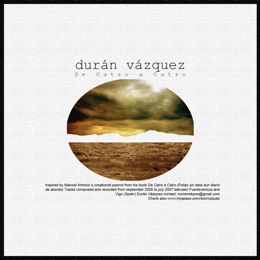
Durán Vázquez has just released “De Catro a Catro†in the Larraskito netabel. Extensive liner notes and link to FLAC or MP3 free download can be found in the Larraskito website.
Neural reviews “Up, Down, Charm, Strange, Top, Bottomâ€

This atypical album is divided into four tracks of unusual and disparate lengths – the first lasts more than twenty minutes, the second and third are less than two minutes long, and the last stretches out to more than forty minutes. ‘Up, Down, Charm, Strange, Top, Bottom’ by Miguel Carvalhais and Pedro Tudela, aka @C, is a collection of sonorities that come from many and various sources. The soundscape forms an eccentric continuum, but one that remains sensitive through the expert use of well-chosen field recordings and an agreeably calibrated overall balance. The listener is also immediately aware of the relationship between the single episodes and the whole composition. The album essentially functions as a label catalogue and is rich in “sample guests.” It also makes good use of sounds accumulated during many live performances, and takes inspiration from previous studio outtakes. Such an assortment is testament to the range of influences at play here. The album is replete with creations that have been born out of fruitful collaborations from previous years. It exhibits sequences with an intense amalgamation, and is rich in very imaginative solutions. It’s a contemporary electroacoustic album, where voices, short instrumental intermezzo, loops and more synthetic drones emerge. There are references to chromo-dynamic and unstable quark-sonic particles (following the same title inspiration, related to the quark electric charge theory). There are six varieties of “flavours” – actually there are many more, because here the abstract music becomes more pertaining to matter and the super-vivid. (Aurelio Cianciotta)
via Neural
Ran Slavin’s “Nocturnal Rainbow Rising†due soon

Ran Slavin‘s new unlimited release in Crónica, “Nocturnal Rainbow Rising†is now in the final stages of production and will be available for free download very soon. This is Slavin’s third full-length release in Crónica, following 2004’s “Tropical Agent / Ears in Water†and last year’s “The Wayward Regional Transmissions†that was awarded an honorable mention at the Prix Ars Electronica.
The cover of “Nocturnal Rainbow Rising†is based in the piece of the same name that will be released as a signed and certified series of ten 50 x 70 cm Lambda prints by Ran Slavin in the limited release series of Crónica.
Pure’s “Ification†is in production

Pure‘s new CD release in Crónica, “Ification†— with wonderful cover art by Jan Rohlf — is now in production and copies are expected soon. In the meantime, you can have a sneak peak here.
This release, mastered by Martin Siewert at Motone Sound Services in Vienna, comprises 7 trackswith collaborations from Christoph De Babalon, Martin Brandlmayr, Alexandra Von Bolzn and Anke Eckardt.
Chão: LX Factory, Lisboa 18-20 September

A long (and interesting) program featuring Osso Exótico, Carlos Santos, EmÃdio Buchinho, André Gonçalves, Nuno Moita, Paulo Raposo, The Beautiful Schizophonic and many others. (Not much) more information at projectochao.blogspot.com.
Cem Güney interviewed by tokafi.com

Cem Güney is the first to admit that Turkey still has a long way to go in terms of radically progressive music and Sound Art. Admittedly, there are hotspots, clearly confined oases of demanding sonic experimentation. But overall, the main focus still seems to be firmly placed on maximising profits and importing ideas instead of exporting the country’s own, undeniable creativity. Güney, then, is a leader in his field. Treading the fine line between Musique Concrete and Contemporary Microtonality, his style has grown from a past in Jazz, DJing and playing the Trumpet into a subtle, psychaoctive amalgam of different influences. His language is prismatically broken along various lines – typical perhaps for an artist who is only starting out career-wise, but also refreshingly diverse and decidedly exciting. Even though obvious oriental or exotic references are all but absent, there is a discreet mysticism emanating from tracks like “Somewhere between the Middle”, which marks Güney as a voice to follow. Considering he has already established contact with labels from all over Europe, it may soon come to be heard far outside of Turkey as one of the country’s first experimental exports.
read the full interview at tokafi.com
Martijn Tellinga performs Xenakis

For this year’s Night of the Unexpected festival, part of Gaudeamus’ Muziekweek, Martijn Tellinga has produced a performance of Iannis Xenaki’s revolutionary Mycenae Alpha, work for computer that was generated with The UPIC system.
The UPIC enabled Xenakis to compose grahically and transform visual information into sound. The UPIC system was conceived by Iannis Xenakis in the early 1950s, the first version of UPIC was built by Xenakis’ research center in the late 1970s, and continues to be developed to this day. With the performance, original slides of the graphical score of the piece will be shown.
Night of The Unexpected will take place coming friday September 5th at Amsterdam’s Paradiso, 20:30. More information at www.thenightoftheunexpected.nl
Vital Weekly reviews Praxis

The name Cem Güney sounds like a name I heard before, but I have no idea when and where. He hails from Turkey, where he taught himself how to play the trumpet and he studied in California. There he got interested in sound art and started to play electronic music. That’s the basic stuff I do understand of the press text. The rest is too hard for me to comprehend. Lots about language, voices, talk, spiritual learning and more such things, but I must admit I have great difficulty in finding out what this has to do with the music he created using laptop, field recordings and radio. It sounds all pretty decent in terms of microsound, glitch and processed field recordings, but I fail to see the relation with language as such. What Güney does here is alright, but there is nothing here that we haven’t heard before. The glitches, hiss, loops, twitter and tweak, it is very common ground. I must say that Güney does a fine job in terms of production and execution but doesn’t get the price for the most original thing of the year.
via Vital Weekly
New CD release: Gilles Aubry’s “Berlin Backyardsâ€

Swiss sound artist Gilles Aubry is no stranger to Crónica, having collaborated in two of the label’s compilations, “Essays on Radio†and “Mus*****câ€. We are now very pleased to present his first CD in Crónica, the exquisite “Berlin Backyardsâ€.
Continue reading “New CD release: Gilles Aubry’s “Berlin Backyards—