“Gamelan Descending a Staircase” reviewed by Kindamuzik

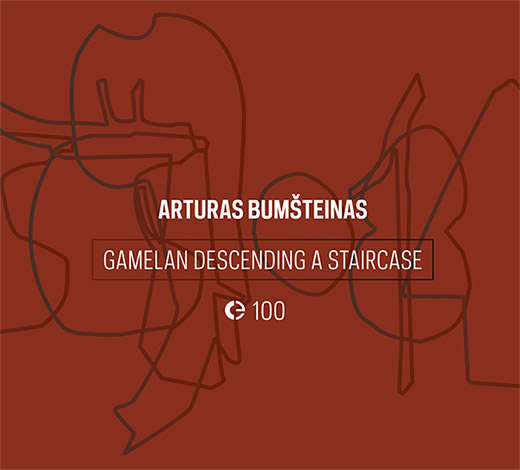
Gamelan Descending a Staircase
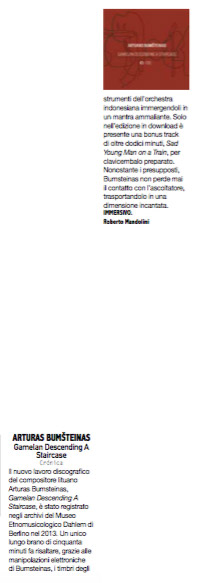
Alsof je het galmende instrument van een trap laat kukelen. Alsof je de naakte klank daarvan buitelend kwinkelerend met een onvast vibrato componeert – trede voor trede – alsof de gamelan met een bruuske schop de hemelen uitgeknikkerd wordt. Alsof een bewust onscherpe foto daarvan liefdevol realistisch geschilderd is op doek door een pietje precies… Met de honderdste release van het label Crónica wekt Arturas BumÅ¡teinas een veelheid aan indrukken en suggesties op, niet in de laatste plaats aan Marcel Duchamp en Gerhard Richter.
De Litouwse componist Arturas BumÅ¡teinas verrast al geruime tijd met intrigerend open werken waarin naakte klanksensaties en verkenningen van timbre en textuur centraal geplaatst worden. Voor Gamelan Descending a Staircase put BumÅ¡teinas inspiratie uit Duchamps doek uit 1912, waarin een naakt van de trap komt lopen; langzaam lijkt het, bedachtzaam – een fragment bovendien, een deconstructie, zonder een duidelijk doel. Die wellicht niet eens behoedzame, maar wel zekere beweging, weloverwogen naar het ongewisse, een afdaling naar het onbekende koppelt BumÅ¡teinas aan een visioen van een gamelanorkest dat letterlijk van een trap valt.
Focus en gebrek daaraan spelen voortdurend door het volledige, vijftig minuten lange stuk. Bij vlagen lijkt het wel een sonische flipperkast, waar harde pinnen de schalen doen twinkelen, terwijl andere vlakken omfloerst lijken door fluweel en dof of gedempt resonanties smoren. De spanning ligt niet in enige erotische sensatie van naaktheid, maar in de bijna Cage-achtige, schier toevallige opeenvolging van klateringen. Voorspelbaarheid wordt afgebroken, structuur raakt ontrafeld en waar het oor mee geconfronteerd wordt, zijn percussieve nanoscherfjes die als fruitvliegjes rond een kaarsvlam flakkerend oplichten en lijken uit te doven. De ene zwalkende boventoon hint direct naar de volgende, duikt onder grommende vibraties in het substraat van laag golvende noten en tikt fel en ferm als belletjes. Meditatief is anders, maar aan deze wolk vol odes aan Cage, Boulez, Xenakis en Stockhausen valt niemand zich een buil. Sven Schlijper

via Kindamuzik

“Modular Works 2015Q1” reviewed by Kindamuzik

cronica098-2015_520
Modulation was op het vorige Le Guess Who?-festival misschien wel de leukste plek. De gekke, kuilachtige zaal maakte het mogelijk om van bovenaf op de tafels met apparatuur te kijken. Daarop: spaghetti aan kabels, effectapparaten en vooral: modulaire synthesizers. De oase van rust ter plaatse werd geruggensteund door tactiele klanken, analoge texturen en de fascinatie naar het zoeken van nieuw geluid in machines met schier eindeloze mogelijkheden. Jos Smolders zou daar niet misstaan hebben. Zeker niet met zijn Modular Works onder de arm.
Bij Smolders tref je hetzelfde aan als bij Modulation let wel – de muziek delft nimmer het onderspit, maar gaat juist hand in hand met een zeker gear-freak-achtig bijna-fetisjisme. Dat evenwicht uit zich bij de uiterst ervaren Smolders in een vrije exploratie van de potentie van compositie als sonische ontdekkingsreis. Denk gerust aan Pierre Henry en Pierre Schaeffer; geluiden als acteurs in klanknarratieven die organisch en vloeiend ontvouwen worden.
Smolders’ modernisme is geconstrueerd uit vakkundig gevormde sculpturale geluiden. Die staan niet zomaar in een loze ruimte, maar worden volgens een strak gecomponeerd structureel plan als in een gebalanceerde expositie neer- en ingezet. Die dramatische (tijd)lijn is in de stukken duidelijk merk- en voelbaar, maar wordt nooit dwingend of verstikkend. In deze ook aan Robert Hampson schatplichtige concrete muziek is er namelijk meer dan een beetje ruimte voor sprankelende dialoog tussen de vele diverse stemmen, partijen en rollen.
Het vraagt lef en visie om coherent samen te binden en toch los te laten, om te componeren en toch researchachtig open te staan voor verrassingen waarvoor processen je stellen. What’s-this-button-for?-knoppendraaierij gaat bij Smolders dan ook fascinerend gelijk op met doelgerichte regie; tussen feit en fictie. Het grootse en meeslepende Modular Works laat na afloop in een luchtledige de vraag of het gepast is stilletjes verzonken in de net geëindigde klankwolk voort te dwarrelen of uit te barsten in klaterend joelend applaus onbeantwoord. Sven Schlijper

via Kindamuzik

Natal dos Experimentais 2015

NatExp2015+5+520
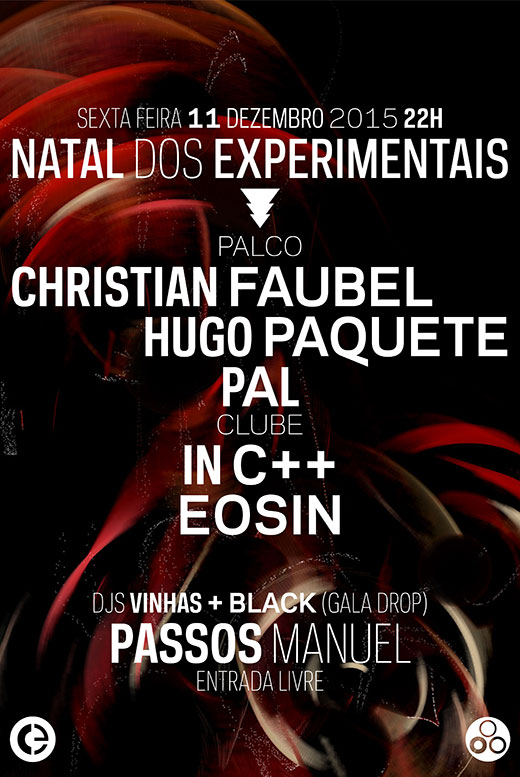
It’s that wonderful time of the year once again, when we gather and celebrate the winter with an evening of live performances at Passos Manuel in Porto.

This year, the program of Natal dos Experimentais will feature five performances and DJs, as well as the usual freebies. In the main stage we’ll have performances by Pal, Hugo Paquete, and Christian Faubel. The Club room will follow with two more performances: Diana Combo’s Eosin; In C++, a trio performance by Vitor Joaquim, Pedro Tudela and Miguel Carvalhais; and Gala Drop’s Black will DJ.

It’s already on Friday, December 11, and as usual everyone’s welcome, and the entrance is free!

More information at the FB event.

“Gamelan Descending a Staircase” reviewed by Taz

Gamelan Descending a Staircase
Ob so etwas im Berliner Schloss auch noch möglich sein wird? Der litauische Klangkünstler Arturas Bumšteinas hat für sein Album „Gamelan Descending a Staircase“ im Jahr 2013 die Archive des Ethnologischen Museums Dahlem nutzen dürfen, um auf Perkussionsinstrumenten des traditionellen indonesischen Gamelan-Orchesters das Material für sein Titelstück, eine fünfzigminütige Großkomposition, einzuspielen.

Als Inspiration diente ihm das skandalträchtige Bild „Nude Descending a Staircase, No. 2“ von Marcel Duchamp. Bumšteinas übertrug die dynamisch geschwungenen Linien von Duchamp in klingende Mikrostrukturen, die von fern an traditionelle Gamelanmusik erinnern mögen, da die Gesamtbewegung seiner Komposition ähnlich ruhig fließend voranschreitet. In ihren Details jedoch erscheint das Resultat bei ihm um einiges zerpflückter.

Die Instrumente wurden von Bumšteinas nach der ursprünglichen Aufnahme noch einmal kräftig elektronisch durcheinandergewirbelt, sodass die Klangfarben zwar überwiegend erhalten geblieben sind, hier und da jedoch leicht verfremdet klingen und insbesondere rhythmisch mitunter in unterschwellig nervöse Flimmerstadien abdriften. Um Bumšteinas’ Idee aufgreifen: So klingt wohl ein Gamelan-Orchester, das die Treppe hinunterfällt. Wer dazu in Trance fällt, muss einigermaßen hart im Nehmen sein.

Ebenfalls von visueller Kunst beeinflusst – audiovisueller, genauer gesagt – ist „Ou“, das jüngste Album der in Berlin lebenden kolumbianischen Musikerin Lucrecia Dalt. Die deutschen Filmemacher Heike Sander und Werner Schroeter insbesondere haben sie zu diesen abstrakten Filmmusiken angeregt, und zwar ganz wörtlich: Filme von Sander und Schroeter liefen während der Aufnahmen zu den einzelnen Stücken. Hier und da verwendet Dalt sogar Samples mit der Original-Filmmusik oder Dialogfetzen, die sie gründlich elektronisch durchgeknetet hat.

Auf „Ou“ fügt Dalt ihr Material zu fragilen Strukturen, die rhythmische Formationen ausbilden oder von allem Beat befreit vor sich hin flirren. Hier gibt es keine Songs mehr wie auf den Album „Syzygy“, Dalt horcht vielmehr ausgiebig in den Klang. Und entfaltet einen Sog, zu dem man Bilder sehen oder hypnotisiert werden mag. Oder dem man sich einfach überlässt. Tim Caspar Boehme

Christian Faubel at FBAUP

Faubel
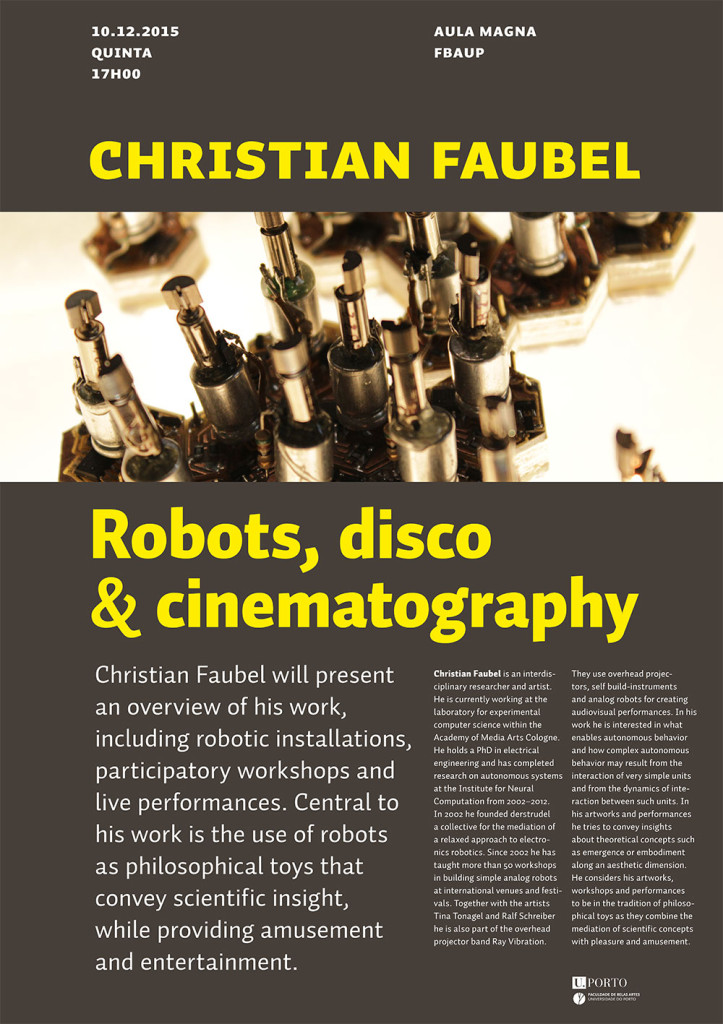
Besides performing at this year’s Natal dos Experimentais, Christian Faubel will also present a lecture at the Faculty of Fine Arts of the University of Porto. In this Faubel will present an overview of his work, including robotic installations, participatory workshops and live performances. Central to his work is the use of robots as philosophical toys that convey scientific insight,while providing amusement and entertainment.

Christian Faubel is an interdisciplinary researcher and artist. He is currently working at the laboratory for experimental computer science within the Academy of Media Arts Cologne. He holds a PhD in electrical engineering and has completed research on autonomous systems at the Institute for Neural Computation from 2002–2012.In 2002 he founded derstrudela collective for the mediation of a relaxed approach to electronics robotics. Since 2002 he has taught more than 50 workshops in building simple analog robots at international venues and festivals. Together with the artists Tina Tonagel and Ralf Schreiber he is also part of the overhead projector band Ray Vibration.

They use overhead projectors, self build-instrumentsand analog robots for creating audiovisual performances. In his work he is interested in what enables autonomous behavior and how complex autonomous behavior may result from the interaction of very simple units and from the dynamics of interaction between such units. In his artworks and performances he tries to convey insights about theoretical concepts such as emergence or embodiment along an aesthetic dimension. He considers his artworks, workshops and performancesto be in the tradition of philosophical toys as they combine the mediation of scientific concepts with pleasure and amusement.

It’s next Thursday, December 10 at 17h. Entrance is free!

Christian Faubel at Natal dos Experimentais 2015

faubel
Christian Faubel is an interdisciplinary researcher and artist. He is currently working at the laboratory for experimental computer science within the Academy of Media Arts Cologne. He holds a PhD in electrical engineering and has completed research on autonomous systems at the Institute for Neural Computation from 2002-2012. In 2002 he founded derstrudel a collective for the mediation of a relaxed approach to electronics robotics. Since 2002 he has taught more than 50 workshops in building simple analog robots at international venues and festivals. Together with the artists Tina Tonagel and Ralf Schreiber he is also part of the overhead projector band Ray Vibration. They use overhead projectors, self build-instruments and analog robots for creating audiovisual performances.
In his work he is interested in what enables autonomous behavior and how complex autonomous behavior may result from the interaction of very simple units and from the dynamics of interaction between such units. In his artworks and performances he tries to convey insights about theoretical concepts such as emergence or embodiment along an aesthetic dimension. He considers his artworks, workshops and performances to be in the tradition of philosophical toys as they combine the mediation of scientific concepts with pleasure and amusement.

Christian Faubel will perform at this year’s Natal dos Experimentais, December 11th at Passos Manuel, Porto.

Hugo Paquete at Natal dos Experimentais 2015

paquete
Hugo Paquete (b 1979) Intermedia and sound artist, which in his research uses concepts about space, noise, error, glitch and micro-tonality as a visual and audible ecosystem according to spatial and Post-digital conditions. In his works he uses technical elements and practices from the field recording to computer generated sound synthesizing and audio spacialization. Denoting interest in stochastic probabilities between computer algorithmic and programming interaction with software and object oriented composition and performance.
He was a resident artist in the ZKM | Zentrum für Kunst und Medientechnologie Karlsruhe, IMA | Institute for Music & Acoustics. He collaborated with the Lithuanian Artist Julijonas Urbonas to the development of the sound composition to the Talking Doors project that earn the Distinction in the Interactive Art category price Prix Ars Electronica 2010, and recommendation jury 14th Japan Media Arts Festival, Tokyo, Japan 2010 and honorary mention in the Media, Live 2011 Grand Prix, Turku, Finland.
Active in national and international art events.-Sonora VII Muestra de Arte Sonoro e Interactivo. Museu Rainha Sofia, Madrid, Espanha 2012. / Audiorama/Ars Acustica 4, Stockholm, Sweden. 2012. / International Radiophonic Creation /Journee de la creation radiophonique – France and other countries. 2012. / SoundGate – A part of Port2010, Kunsten Museu, Utzon Centre and Platform4, Dinamarca, 2011Sonic Vigil V, Sound Station, St Fin Barre`s Cathedral – Ireland, 2011. Festival Música Viva 2008-2009, Centro Cultural de Belém, Lisboa –Portugal / 39- Imebconcours internationaux de Bourges Musiques electroacoustiques et arts electroniques 2009 –France / Zeppelin 2009 Sounds of power / Listening of fear. Centre de Cultura Contemporània de Barcelona –Spain / Art Tech Media 2007, Madrid –Spain / Festival DAW 07, Centro de computação Zurich –Switzerland / File 2007, Electronic Language International Festival, São Paulo –Brasil / and others.

Hugo Paquete will perform at this year’s Natal dos Experimentais, December 11th at Passos Manuel, Porto.

Eosin at Natal dos Experimentais 2015

eosin
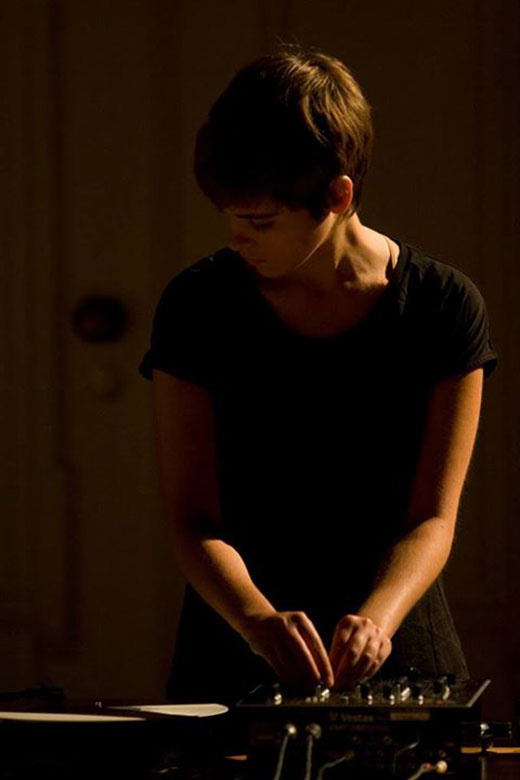
Eosin (Diana Combo) started composing and performing with vinyl records with fragmentation and collage in a process akin to plunderphonics. This approach gradually gave way to a more elaborate composition work, that also started to include field recordings. Diana has performed widely using vinyls as instruments for improvisation, crossing paths with Andrea Neumann, Ana Veloso, João Martins and Filipe Silva; Antoine Chessex, Werner Dafeldecker, Burkhard Beins, Nate Wooley, among others. She has performed solo in festivals as Transmediale, Tiny Noise, and ERTZ, and venues as Casa da Música, Passos Manuel, Maus Hábitos, ZDB, Galeria Zaratan, Bar Irreal, Salon des Amateurs, and General Public.

Eosin will perform at this year’s Natal dos Experimentais, December 11th at Passos Manuel, Porto.

Futurónica 154

futurónica_154
Episode 154 of Futurónica, a broadcast in Rádio Manobras (91.5 MHz in Porto, 18h30) and Rádio Zero (21h GMT, repeating on Tuesday at 01h) airs tomorrow, November 27th.

The playlist of Futurónica 154 is:

  1. Bernard Parmegiani, Incidences / Résonances (1975, De Natura Sonorum, Recollection GRM / Editions Mego)
  2. Bernard Parmegiani, Accidents / Harmoniques (1975, De Natura Sonorum, Recollection GRM / Editions Mego)
  3. Bernard Parmegiani, Géologie Sonore (1975, De Natura Sonorum, Recollection GRM / Editions Mego)
  4. Bernard Parmegiani, Dynamique De La Résonance (1975, De Natura Sonorum, Recollection GRM / Editions Mego)
  5. Bernard Parmegiani, Étude Élastique (1975, De Natura Sonorum, Recollection GRM / Editions Mego)
  6. Bernard Parmegiani, Conjugaison Du Timbre (1975, De Natura Sonorum, Recollection GRM / Editions Mego)
  7. Bernard Parmegiani, Incidences / Battements (1975, De Natura Sonorum, Recollection GRM / Editions Mego)
  8. Bernard Parmegiani, Natures Éphémères (1975, De Natura Sonorum, Recollection GRM / Editions Mego)
  9. Bernard Parmegiani, Matières Induites (1975, De Natura Sonorum, Recollection GRM / Editions Mego)
  10. Bernard Parmegiani, Ondes Croisées (1975, De Natura Sonorum, Recollection GRM / Editions Mego)
  11. Bernard Parmegiani, Pleins Et Déliés (1975, De Natura Sonorum, Recollection GRM / Editions Mego)
  12. Bernard Parmegiani, Points Contre Champs (1975, De Natura Sonorum, Recollection GRM / Editions Mego)
  13. Bernard Parmegiani, Mouvement 1 (2002, Sonare, INA-GRM)

You can follow Rádio Zero’s broadcasts at radiozero.pt/ouvir and Rádio Manobras at radiomanobras.pt.