“strings.lines” reviewed by Cyclic Defrost

strings.lines
Nicolas Bernier’s Strings.Lines uses tuning forks, violin and viola de gamba to produce music that effortlessly evokes early music and also the future. Bernier has these ancient instruments weave slow, graceful, often pained patterns akin to the trio sonatas of baroque composers, but pits these against extreme high and low sustained tones from the tuning forks that most closely recalls the sine waves of Ryoji Ikeda. Before reading the notes to the release that is exactly what I thought was happening, contemporary works for strings and digital electronics.

The glacial gloom conveyed from the strings is actually closer to work by backwards-looking contemporary composers like Arvo Part and Valentin Silvestrov, but like their music a timeless simplicity is present. The forks produce almost painful drones which the players try to match, happily sliding off course to create sorrowful improvisations around these fixed points. The forks also slip and slide, producing acoustic “glitches” comparable to the slips created by the performers. This is a marvellous recording of new music which engages with history in surprising and disorienting ways. Joshua Meggitt

via Cyclic Defrost
“strings.lines” reviewed by Rockerilla

strings.lines
Cinque tracce in cui la viola da gamba di Pierre-Yves Martel e il violino di Chris Bartos accompagnano i detriti orchestrati da Nicolas Bernier. Un’intesa miracolosa che genera un lavoro spettacolare in cui le corde inciampano in melodie senza tempo prima di rantolare in vicoli senza luce. “Line (A)”, la seconda traccia in scaletta, è la porta d’accesso all’universo in bianco e nero di Bernier, un mondo in cui ogni particolare racchiude una storia. Senza souzione di continuità le tracce si susseguono in un racconto emozionante, che se da una parte potrebbe ricordare una colonna sonora di un cartone animato di Tim Burton, dall’altra mostra tutta la carica visionaria di un musicista come Nicolas Bernier. Meraviglioso. Roberto Mandolini

Futurónica #28


Episode 28 of Futurónica, a broadcast in Rádio Zero (every two weeks, on Friday nights, repeating on Tuesdays at 01h) airs tomorrow, February 11th at 21h (GMT).

The playlist for Futurónica #28 is:

  • The Camberwell Now, For Those Who Peril on the Sea (1985, The Myths Collection Vol. 1, Sub Rosa)
  • Kevin Drumm, Stochastic Sophistication (2010, The Obstacles of Romantic Exaggeration, Karl Schmidt Verlag)
  • Robin Fox, Impossible Futures (2010, 10, Room 40)
  • Kevin Drumm, Fauxnakis (2010, The Obstacles of Romantic Exaggeration, Karl Schmidt Verlag)
  • Aphex Twin, Nanou 2 (2001, Drukqs, Warp)
  • Ø, Hikari (2010, Heijastuva, Sähkö)
  • Kevin Drumm, Nanoplankton (2010, The Obstacles of Romantic Exaggeration, Karl Schmidt Verlag)
  • James Eck Rippie + Paulo Raposo, Natureza Morta (2005, Product, Crónica)
  • Aphex Twin, Gwarek 2 (2001, Drukqs, Warp)
  • Kevin Drumm, Humidity Can Suck It (2010, The Obstacles of Romantic Exaggeration, Karl Schmidt Verlag)

You can hear Rádio Zero’s broadcasts at radiozero.pt/ouvir.

“strings.lines” reviewed by Sentire Ascoltare

strings.lines
Dei diapason. Guide quasi morali. Le “linee” a cui fa riferimento il titolo del nuovo suggestivo lavoro di Nicolas Bernier sono “tuning fork”, strumenti di accordatura e curiosi spiriti di metallo che riproducono un “puro tono”, a cui anelare. Per un anno e mezzo (settembre 2008-febbraio 2010), Nicolas ha seguito la fascinazione di ciò che detta la regola: ha chiamato a sé due suonatori d’archi, Pierre-Yves Martel (violista) e Chris Bartos (violinista) e insieme hanno esplorato le risorse asintotiche del tuning attorno a una determinata frequenza. Bernier, compositore elettroacustico canadese (curiosamente omonimo di un compositore francese del Seicento), ha miscelato questi elementi riuscendo a creare una ricerca sui timbri di grande impatto, con un’insistenza e un’intensità che ricordano le notti di Giacinto Scelsi, più che le ricerche di Luciano Berio. Funziona particolarmente la dinamica e il sistema di relazioni che si creano tra layer ambiental-elettronici (sfrigolii so sticati n quasi al silenzio, a volte – line (c) – formicai percussivi) e le note acustiche (line (a)), prolungate no a essere un mantra dell’essenza. Ciò che sembra paradossale, ma solo in apparenza, è la possibilità di fare improvvisazione attorno al concept di String Lines. Non è per nulla inconcepibile maturare un approccio alla nota che per quanto si avvicini la rifugga, ne colga interstizi, vie d’uscita, mimetizzati nella ripetizione.

L’ascoltatore vive una piccola narrazione, dalla quale è costretto a rimanerne escluso. È imbavagliato, come in una camicia di forza, dall’ipnosi dei forks, e gode, impotente, della maestria altrui nel fare fuga e trovare escamotage per ravvivarne le potenzialità compositive. (7.2/10) Gaspare Caliri

New podcast: Enrico Coniglio

21st November
Going with my binaural mics on the 21st November 2010 to the Basilica of St. Mary of Health (in italian “Basilica di Santa Maria della Salute”) at Punta della Dogana (Venice-Italy), during the typical feast-day. Thousands of people visit the main altar of the church to give thanks to the Virgin Mary and ask to keep them in good health. The church was built in 1631 after the Senate decided to honor the Virgin Mary of Health for delivering Venice from a plague.

This is a composition of raw recordings take with binaural microphones. From the minute 0 to 5:50 I’m walking over the “Ponte votivo”, a temporary bridge set up on barges over the Grand Canal, and then through narrow streets until to reach the church and enter in the middle of the hall. From 5:50 to 8:50 I’m walking slowly through the crowd towards the main altar and then behind, to sit on the “coro” stalls where people stop, pray and pass in front a Virgin Mary icon. From the minute 08:50, you can hear a series of recordings of prayers and organ tunes.

Use headphones for best result. Photo by Donato Gagliano.


Flash is not installed

Download here or subscribe to the podcast in iTunes.

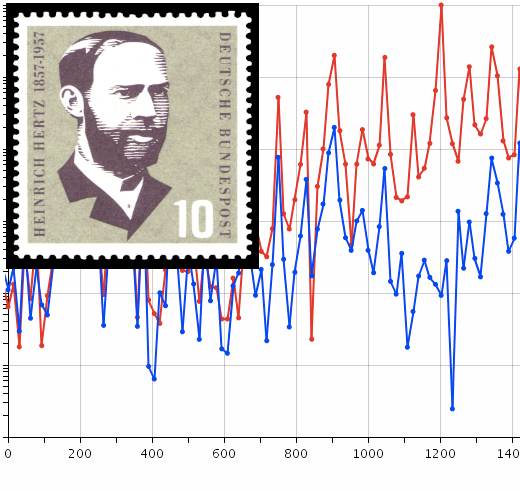
Open call for participation: Hertz Celebration Project


Rádio Zero is preparing a special and colaborative streaming event to comemorate Heinrich Hertz birthday next February 22.

Hertz experiments with electromagnetic waves were in the very basis that led to the to the development of the radio. And his name became the term used for radio and electrical frequencies: hertz (Hz), as in kilohertz (kHz) or megahertz (MHz).

Radio Zero will organize a multiple stream session and invites you to join in and choose to perform within one of these 5 frequency ranges : 80-200 Hz, 200-500, 500-800, 800-2.000, 2.000-20.000.

Each frequency slot will have a length of 15m.

Deadline for confirmation: 15 February, more information at Rádio Zero.

“Passeports” reviewed by Terz

Passeports
Auch hier geht es um den Konnex zwischen Audio und spezifischen Räumen. Die 7 Stücke bilden sich um field recordings aus konkreten französischen Orten, in denen es um Transport geht: Bahnhöfe, Häfen, Parkplätze und Transit-Areale. Die Klangerfahrungen werden verdichtet und in Innenräumen zu einem Ambient verdichtet, der Fragen nach Raum und Verortung von Klang stellen möchte. Honker