“No End of Vinyl” reviewed by Neural

No End of Vinyl
From Crónica Electronica come ten new reinterpretations, reflecting on “the end of vinyl or the end of the world”. Although there is some underlying thematic irony here, the Portuguese label has maintained its customary formal accuracy and clarity of aims with this release, thanks in part to Pure and Miguel Carvalhais. Both have been active on the production side, giving new life to the the.end.of.vinyl release, which was originally recorded by Pure in 1999 and has been out of stock for some time. Hiding behind the monikers of Pure and Current 909 is Peter Votava. The Austrian producer, who currently lives in Berlin, has moved from the analogue domain into digital production. This is the first work in his catalogue where the focus is on pure listening as opposed to functional dance music. The original Pure album was not a manifesto against vinyl records but a reference to the different sources of the music, which arose out of samples that have now become the inspiration for new rarefied audio sequences. We won’t mention anyone in particular, because with names such as @c, Christoph de Babalon, Jorge Sánchez-Chiong, Cindytalk, Goner, Pita, Rashad Becker, Arturas Bumšteinas, Opcion and, last but not least, Pure, we need to mention all of them. The selection of music is fantastic and the album is available on Bandcamp for a symbolic-or-higher-if-you-want price tag. Aurelio Cianciotta

via Neural

“Ab OVO” reviewed by Blow Up

Ab OVO
Il progetto parte dalla musica per uno spettacolo di burattini. Potrebbe nascere dalla domanda: ma che c’è nella testa di una marionetta? Ma posta non da uno psichiatra, da un fisico esperto in elettromagnetismo. Ne esce un incrocio tra Frankenstein Jr. (ma serio) e Capitan Nemo. Magmatiche maree sonore e derive percussive, con in mezzo una notevole escursione meditativa. Peccato che ci sia solo la musica. G. Dal Maso

“Concret-Sens” reviewed by Blow Up

cronica084-2013_520
Neon, prese elettriche, nastri registrati, field recordings: EM ne cava fuori tre suites. A che pro una musica (musica?) del genere? Forse è un modo per riflettere sulla concretezza e sul senso dei suoni che ci circondano. Sarà, purtroppo a me piace. G. Dal Maso

“Concret-Sens” reviewed by Chain D.L.K.

cronica084-2013_520
Named after a combination of French words – the word sens (meaning direction) and the French adjective concrescence that the living legend Francois Bayle, who also coined the term “acousmatic” and inventor of “Acousmonium”, used to describe the concrete substance of sounds and its intrinsic impermanence and ruggedness -, this interesting release by Emmanuel Mieville keeps faith with its title as it sounds like an asymptotic approach to the core of musique concrete, as conceptualized by Pierre Schaeffer. While he focused on aural perception of specific environments and sonic “anamnesis” of different urban and wildlife locations on “Four Wanderings in Tropical Lands” that I introduced on this zine a couple of years ago, Emmanuel seems to develop the three sound structures of “Concret-Sens” by coalescing field recordings, other found sounds/objects, pre-recorded stuff and radio snippets without lessening listener’s chance to phase them in possible narrative buildups: the lack of uttermost objectification of sound material is particularly clear on the central structure, “Locus Sonus”, as the combination of field recordings with tapes and radio documentaries seem to evoke personal historical elements and educational memories of the composer, whose first learning steps as apprentice at Groupe de Recherches Musicales in the field of musique concrete got based on creative radio programs and live concerts and the boundaries between objectivity of sound objects and listener’s subjective translation seems to be also quite veiled on the initial “Cillages”, whose almost orchestral concoctions of recordings of neon lights and hums from electrical outlets manages to feed listener’s imagination as the development of the track could let you think about the testing of an unknown Tesla deep fryer. The final piece “Solis Ortus” is an admirable assay of manipulation of field recordings by means of granular synthesis, whose resulting particles crams the sonic sphere by degrees. Vito Camarretta

via Chain D.L.K.

Marc Behrens and Atom™ release “Bauteile”

bauteile
The over 70 minutes of “Bauteile” (German for “construction parts”) were recorded from 1987 through 2013 and edited into a continuous flow over the last three years. Atom™ and Marc Behrens met during the heyday of the German Techno movement and have since ever pursued extensive research in all areas of contemporary music. Their findings, a sonification of their investigations, which span effectively two centuries of musical development, are now released as an album for the first time by Editions Mego.

Recorded on Earth, 1987–2013. Produced, assembled, edited, mixed and mastered at Bowman Suite, Santiago, Chile. Violin: Carlos Zingaro.

“Ab OVO” reviewed by Black

Ab OVO
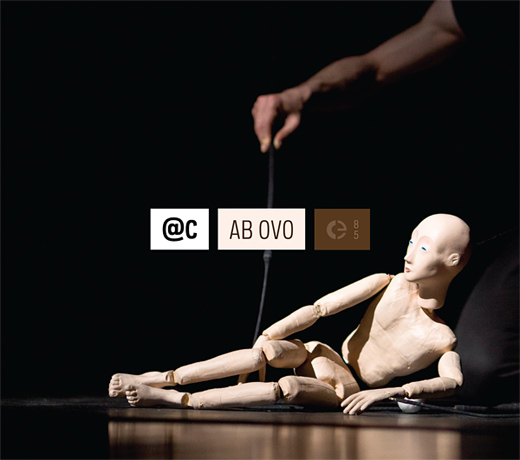
Wie schon mehrmals angedeutet, bewegt sich Ambient gerne in einem Art-Kontext und im Falle von @C wird diese Beziehung besonders deutlich. Das Cover des Albums „Ab Ovo“ zeigen unbearbeitete Puppen, solche die man im Fachhandel für Malerei findet und die angehenden Zeichnern als Grundlage für biomechanische Eigenheiten des Menschen darstellen. Nur sind diese Puppen auf dem Cover mit Schnüren versehen, die ein Puppenspieler braucht um Figuren zu bewegen. Daraus ergibt sich die erste Frage: handelt es sich bei „Ab Ovo“ um den Soundtrack zu einem Figurentheater? Auch die Musik eröffnet diesen Deutungsspielraum. Leise blubbernd gehen Klangflächen mit Geräuschkollagen Hand in Hand, bestens geeignet, menschliche Emotionen aus dem Gleichgewicht zu bringen. Gut vorstellbar, dass dieser hohe Grad klanglicher Abstraktion den Zweck verfolgt, Publikum bei einer Aufführung zerrissene Emotionalität zu verdeutlichen, das bei einem Puppenspiel auf der Bühne gerade aufgeführt wird. Ansonsten handelt es sich um soliden Dark Ambient. Die angesprochenen Klangflächen werden nicht durch die einzelnen Stücke durchgezogen sondern verbiegen oder verschwinden hintern aufgesetzten Klangkollagen, die aus elektronischen Beeps und Blips bestehen, die ergänzt werden durch verfremdete akustische Elemente, wie zum Beispiel eine anklingende Gitarren- oder Celloseite. Diese Komplexität und der Hang zur Verfremdung der üblichen Hörgewohnheiten gibt „Ab Ovo“ eine eher beklemmende Note und dieses Element wird meisterlich vorgeführt, so dass man als Hörer eine Beklommenheit oder Unwohlsein in sich aufsteigen fühlt.

Schwere Kost aber hohe Kunst.

via Black

New release: “Residual Forms” by Monty Adkins

Residual Forms
Crónica is very proud to present the new release by Monty Adkins, “Residual Forms”, now available as a free download.

an urban drift
with labyrinthine paths
of intoxicating bliss

residual forms
dance on the retina
of one too tired to dream

“Residual Forms” is influenced by the psychogeographical notion of the ‘drift’ – an aimless wondering around the city, exploring its hidden resonances, which lay just beneath the surface. As a runner I often explore new cities by just taking off for a couple of hours, going where I feel or where looks interesting no matter how tired I am or what the time is. Often, at night the city plays tricks with the mind. Running through unknown streets as darkness falls one recalls half remembered places, past memories blur the present experience to create one’s own fiction of place.

Although “Residual Forms” is not a portrait of any one city, it is influenced by the psychogeographical writings of Iain Sinclair and his approach to London, which harks back to the visionary writing of William Blake. Sinclair portrays London as a city inseparable from its history both real and imagined. Merlin Coverley writes that in Sinclair’s work “London’s topography is reconstituted through a superimposition of local and literary history, autobiographical elements and poetic preoccupations to create an idiosyncratic and highly personal vision of the city.”

“Residual Forms” is a psychosonographic portrait of a city that takes listeners on their own imaginary drift.

“Residual Forms” is now available as a free download directly from Crónica or from Crónica’s Bandcamp page.

Arturas Bumšteinas releases “Epiloghi”

Epiloghi
Arturas Bumšteinas has just released “Epiloghi” through the Unsounds label. “Epiloghi” brings together two important sound works by Bumšteinas: Six Ways of Saying Zangtumbtumb and Night on the Sailship. These are highly inspired pieces combining layered historical references with a captivating sound world.

More information at Unsounds.

“Ab OVO” reviewed by Rifraf

Ab OVO
Ecrit pour un théâtre de marionnettes de Porto, ‘Ab OVO’ de la paire locale @C (Crónica) pratique lui aussi, voire davantage, l’art consommé de la réunification bruitiste. A l’instar de l’incontournable collaboration entre l’artiste noise Peter Rehberg et la chorégraphe Gisèle Vienne, les transformations sonores du duo portugais se suffisent pleinement à elles-mêmes – même si nous ne doutons pas un seul instant de la plus-value visuelle de sa contrepartie scénique. Comme d’habitude chez Miguel Carvalhais et Pedro Tudela, et on ne va pas s’en plaindre, l’approche conserve une part de radicalité tranchante, hormis sur les plus sereins ‘100’ (et ses trois guests) et ‘102’. Et tel un magma de circuits électroniques en fusion, on s’empare de l’objet pour ne plus le lâcher.

Fabrice Vanoverberg