

Pont Sonore Belju / Belju sound bridge
During summer 2009, sound artists Gilles Aubry, Stéphane Montavon and Carl Y are constructing an archive of environmental sounds around the Swiss-French border, precisely on the Canton Jura (CH) and Territoire de Belfort (F). Their work documents the sonic landscapes of natural, urban and industrial sites of this transnational area, in particular those of transit of individuals and goods between both sides of the border.
The sound recordings are combined together and redistributed in the public space via the internet, following the idea of temporarily deconstructing the representations of geographical and cultural borders. Four permanent listening sites are installed in the cities of Belfort (F), Bourogne (F), Delémont (CH) and Porrentruy (CH), starting the 15th of August until the 12th of September 2009.
On the web, the Belju sound bridge exists as a playable sound archive and a blog, open to contributions of the public. Live performances and interventions with international guest artists take place on various locations on this territory during the project.
“Lovely Banalities†reviewed by Orkus

Es kann auch mal zu viel Gezirpe sein. Wie viel tatsächlich zu viel ist, verdeutlicht in dem Fall Lovely Banalities von Gintas K. Auf einer nebensächlichen Ebene durchaus als Hintergrundmusik für ein psychologisches Science Fiction-Filmexperiment geeignet, verlangen die 14 Tracks dem Hörer eindeutig zu viel Konzentration und Geduld ab, um tatsächlich als genießbares Etwas konsumiert zu werden. Brodeln, Fiepen, Zirpen, Quietschen, Knistern, Rauschen. Brummen, Summen, Schwelen, Dröhnen, Knacken. Klar so weit ? Bei aller Liebe zu technischen Details und Aufnahmen bleibt zu wenig von dem hängen, was als “Hörvergnügen” klassifiziert werden könnte, sodass Lovely Banalities letztlich genau das bleibt, was der Titel suggeriert: eine im Ansatz gut gemeinte, für die nächste Science Fiction-Rollenspielrunde geeignete, aber insgesamt blasse Tonsammlung.
“See This Sound†exhibition at Lentos Kunstmuseum Linz
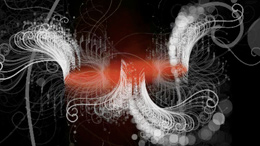
Construction 76, a video by Lia with sound from @c, will be part of the See This Sound exhibition, opening tomorrow at the Lentos Kunstmuseum in Linz, Austria. See This Sound runs until January 10 and was curated by Cosima Rainer, with artistic and academic supervision of Stella Rollig and Dieter Daniels, featuring a long list of artists: Laurie Anderson, Martin Arnold, Michael Asher, Atelier Hopfmann (Judith Hopf und Deborah Schamoni), John Baldessari, Gottfried Bechtold, Jordan Belson, Manon de Boer, George Brecht, Mary Ellen Bute, John Cage, Lucinda Childs, Ira Cohen, Tony Conrad, Josef Dabernig, E.A.T. – Experiments in Art and Technology, Einstürzende Neubauten, Viking Eggeling, VALIE EXPORT, Oskar Fischinger, Morgan Fisher, Andrea Fraser, William Furlong, Kerstin von Gabain, Jack Goldstein, Douglas Gordon, Dan Graham, Rodney Graham, Granular Synthesis, Brion Gysin, Carl Michael von Hausswolff, Gary Hill, Ludwig Hirschfeld-Mack, Heidrun Holzfeind, Derek Jarman, Jutta Koether, DIE KRUPPS, Peter Kubelka, Louise Lawler, Bernhard Leitner, LIA, Alvin Lucier, Len Lye, George Maciunas, Christian Marclay, Norman McLaren, Jonas Mekas, Michaela Melián, Robert Morris, Christian Philipp Müller, Wolfgang Müller, Max Neuhaus, Carsten Nicolai, Pauline Oliveros, Yoko Ono, Dennis Oppenheim, Nam June Paik, Nam June Paik & Jud Yalkut, Norbert Pfaffenbichler & Lotte Schreiber, Rudolf Pfenninger, Adrian Piper, Mathias Poledna, Hans Richter, Józef Robakowski, David Rokeby, Constanze Ruhm und Ekkehard Ehlers, Walter Ruttmann, Peter Saville, Paul Sharits, Michael Snow, Imogen Stidworthy, Matt Stokes, Nina Stuhldreher, Atsuko Tanaka, TeZ, Throbbing Gristle, Tmema (Golan Levin und Zachary Lieberman), Ultra-red, Steina Vasulka, Ryszard Waśko, Peter Weibel, Hans Weigand, Herwig Weiser, James Whitney, La Monte Young, La Monte Young & Marian Zazeela.
“Lovely Banalities†reviewed by Sonic Seducer
Skizzenhafter Musik haftet leider immer ein wenig der Hauch des Halbgaren an, erst Recht auf Albumlänge. Dass dem nicht so sein muss und Musik in kleinen Happen durchaus auch von Vorteil sein kann, beweisen die liebenswerten Banalitäten von Gintas K. 14 kurze elektronisch Stücke, manchmal nicht viel mehr als das schnelle Ausloten eines Sounds, oftmals aber auch umfassend eingefangene Stimmungsbilder. Stücke wie “Q” zeigen, wie mit einfachsten Mitteln wunderbare Moodmusik erschaffen werden kann, die trefflich die Stimmung und Atmosphäre langer Nächte verbreitet. Wohlgemerkt – allein mit Mitteln der Kleinstteilelectronica – mit Knistern, Bleepen, Rauschen und Knacken. Tipp!
UBERMORGEN.COM at ISEA 09

UBERMORGEN.COM will present their keynote “Superenhanced” at this year’s ISEA in Belfast, tomorrow at 5PM. Their installation “Superenhanced Guantanamo Military Tribunal” is on display at the Golden Thread Gallery in Belfast.
Glitch: Designing Imperfection
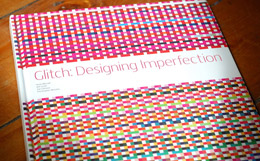
Glitch – Designing Imperfection was curated and edited by Iman Moradi and Ant Scott, and it features work from several of Crónica’s artists and friends, and interviews with Angela Lorenz, Ant Scott, Kim Cascone, O.K. Parking, Johnny Rogers and a Foreword by Per Platou. This 132 page book will be available in September, but you can pre-order it through amazon: http://www.amazon.com/dp/0979966663 http://www.amazon.co.uk/dp/0979966663/ http://www.amazon.de/dp/0979966663/ http://www.amazon.co.jp/dp/0979966663
“Compilation Works 1996-2005†reviewed by Bad Alchemy

Einen 10-jährigen Querschnitt durch das Schaffen des Darmstädter Klang & Mehr-Künstlers MARC BEHRENS bietet Compilation Works 1996-2005 (Crónica 041, Digital release). Behrens ist Citoyen des Königreichs Elgaland-Vargaland (KREV), mit guten Connections nach Lissabon, wo er 2003-07 das Label Sirr mitleitete. Die Zusammenstellung umfasst seine Reinterpretationen von Disinformationen, John Hudak, Ilios, TV Pow und Ralf Wehowsky, seine Reaktionen auf Fotos, gefunden an Straßenlampenpfosten in Afghanistan, und auf den Ausbruch des Irakkrieges, wie er ihm aus Taxis und Bars in Lissabon zu Ohren kam. Bei diesen Publikationen auf Alluvial Recordings, Antifrost, Ash International, Atavistic/EMK, ATAK, Banned Productions, Meme, Mille Plateaux, Raster-Noton, Selektion, Sirr findet man direkte Widmungen an Coca Cola, Dimitris Kariofillis (Ilios & Antifrost) und die griechische Performancekünstlerin Lida Patta und indirekte an Chris Marker und Stockhausens Gesang der Jünglinge. Der zerebrale und mehr noch der physische Mehrwert von Behrens unspektatkulärer Soundart erschließt sich meist erst mit Gebrauchsanweisung. Vieles riecht nach Dokumenta X, Interpretation ist gefragt. Ohne den Kontext einer Installation oder Performance bleibt Vieles grau in grau.
Janek Schaefer interviewed by Ear Room
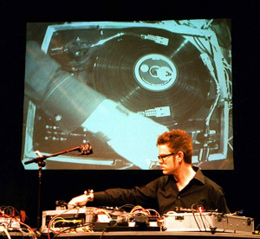
Janek Schaefer is a UK based sound artist, musician, and composer born in England to Polish and Canadian parents in 1970. His concerts and installations explore spatial and architectural aspects of sound, and employ hybrid analogue and digital techniques, modified vinyl, and found sounds. Janek’s work has been exhibited and released by numerous galleries and labels across the globe and in 2008 he won The British Composer of the Year Award for Sonic Art & The Paul Hamlyn Award for Composers Prize.
Full interview at Ear Room.
Janek has released “Hidden Name†(with Stephan Mathieu) in Crónica and has a new work in preparation.
“Lovely Banalities†reviewed by Bad Alchemy
Via Berlin und Lissabon erreichten mich Klänge aus Litauen. GINTAS K hat daheim in Marijampolé aus Klängen, die er an einem windigen Sonntagnachmittag beim Spazierengehen einfing, und Alltagsgeräuschen im Haus – ein Besetztzeichen des Telefons z.B. – 14 Lovely Banalities (Crónica 040) für ein Audiopoesiealbum gesammelt. Seine beiläufigen Funde, der Wind, Vögel, der Klang seiner Schritte, ein plätschernder Bach etc., sind eingebettet, eingearbeitet in laptop-typisch rauschendes Gedröhn, gelegentlich rhythmisiert, meinst nur flatternd zermulcht, kraus gewellt, aufgeregt tüpfelig, gesprüht, kullerig. Melodisches Summen mischt sich mit einer brachialen Kaskade, Glitches brodeln, es furzelt, blitzelt, funkelt, stottert. Die immer wieder hörbaren Schritte erinnern, wohl gewollt, an Musorgskys Bilder einer Ausstellung und an sich Unbemerkenswerten. Die Ästhetisierung des Alltags durcht den Alltag ? Warum fällt mir jetzt der Politiker ein, der vorkaute, dass man mit 5€ am Tag fürstlich leben kann?