Degti was premiered on September 12, 2019 at Vilniaus Degtinė, a vodka factory in Vilnius, during the Muzika Erdvėje festival, with an audience consisting solely of Vilniaus Degtinė employees. Degti invites listeners to re-imagine the recordings made at the factory not as a soundtrack of labour, monotony and production but as a ghostly presence, purposely created to be purposeless. It celebrates mechanical character while attempting to remove links to specific sounding objects. This dual identity within the machines, partly material and partly transcendental, unfolds in compositional time during which matter transforms into spirit while spirit is embodied in the machines.
Be Pavadinimo was composed in 2019, based on environmental sounds recorded in various locations in Greece and Lithuania. Variations of the piece were performed in POKŠT Gallery in Utena and in Kirtimų Kultūros Centras in Vilnius.
Yiorgis Sakellariou is a composer of experimental and electroacoustic music. Since 2003 he has been active internationally, publishing solo and collaboration albums and presenting numerous sonic performances. He has composed music for short films and theatre plays, led workshops and moderated soundwalks.
His practice focuses on the communal experience of listening and the communication between composer, audiences, performance spaces and the rest of the physical and supernatural world. He only performs in absolute darkness, fostering an all-inclusive and profoundly submerging sonic experience.
He completed his PhD at Coventry University (April 2018) with research that drew inspiration from ethnomusicological and anthropological contexts and explored the sonic symbolism and socio-aesthetic settings in ecstatic religious rituals in relation to field recording, electroacoustic composition and acousmatic performance.
Yiorgis Sakellariou is a member of the Athenian Contemporary Music Research Centre, the Hellenic Electroacoustic Music Composers Association and the Lithuanian Composers Union. Since 2004 he has curated the label Echomusic. He is currently a lecturer at Vytautas Magnus University (Faculty of Arts) and at the Lithuanian Academy of Music and Theatre (Department of Composition).
Degti is now available as a limited-release tape, a download or stream, from Crónica and the usual places. The tape includes an exclusive extra track, Degti (reprise).
Crónica bringen am 22. Juni eine Arbeit des griechischen Komponisten Yiorgis Sakellariou auf Tape heraus. “Degti†ist eine aus zwei elektroakustischen Soundscapes (und einem in der digitalen Versioin nicht enthaltenen Bonustrack) bestehende Arbeit, die vor knapp zwei Jahren in der litauischen Brauerei Vilniaus Degtinė aufgeführt wurde – wie üblich bei Sakellarious Werken im abgedunkelten und so auf die totale Akustik zurückgeworfenen Raum und mit einem ausschließlich aus Mitarbeitern der Brauerei bestehenden Publikum.
Die hier vorliegenden Aufnahmen, die das Soundmaterial der Aufführung enthalten, wurden ebenfalls in den Räumen der Brauerei und mit verschiedenen der dortigen Objekte gemacht. Ihre nachträgliche Unkenntlichmachung in einer dunklen Klanglandschaft transformiert die Fabrik in einen schemenhaften Ort und lässt die klangliche Dokumentation als Geisterarbeit (man muss vielleicht nicht den etwas inflationär und zweckentfremdet gebrauchten Begriff Hauntology verwenden) erscheinen lässt.
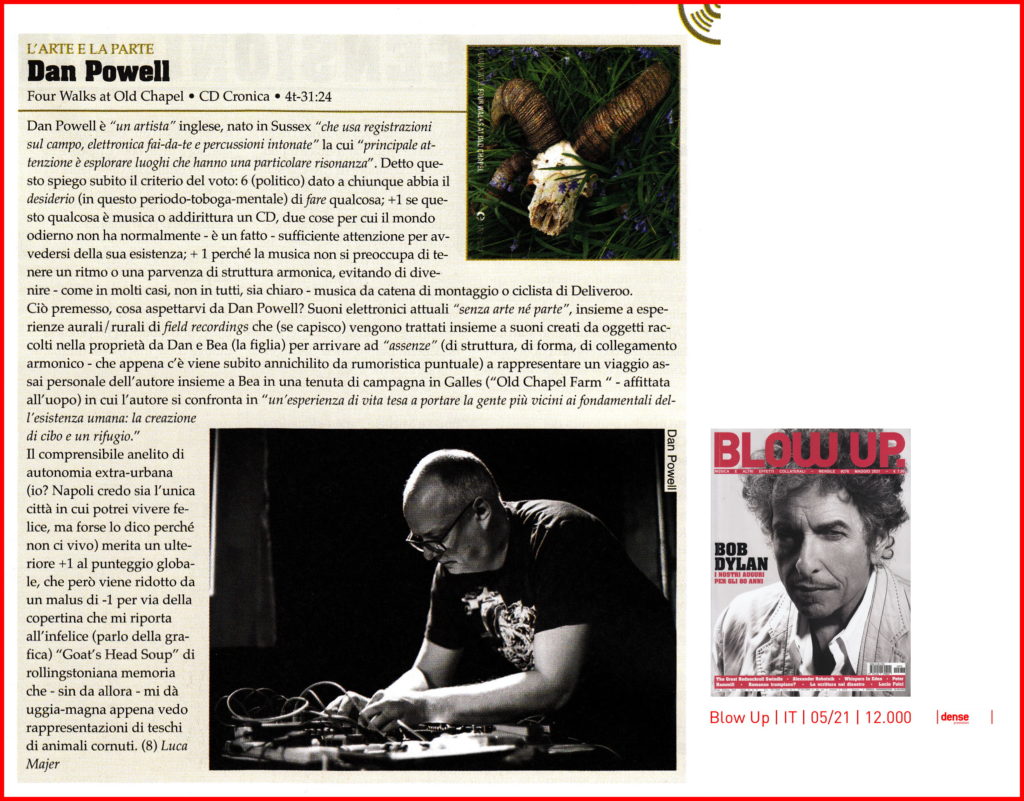
Dan Powell è un sound artist originario dell’Essex e di stanza a Brighton. La sua produzione musicale si distingue per il ricorso a una combinazione di field recordings, frammenti elettronici autoprodotti e percussioni e per l’attività nel campo dell’improvvisazione elettroacustica.
A maggio di quest’anno, Dan Powell ha pubblicato un album registrato tra il 2016 e il 2018 alla Old Chapel Farm, nel piccolo villaggio di Tylwch, in Galles. Il concept alla base di “Four Walks at Old Chapelâ€, uscito per la label portoghese Crónica, è quello di mettere in musica l’esperienza in una fattoria di Tywlch, dove Dan Powell si è recato con sua figlia Bea. Lì, i due hanno raccolto oggetti vari rinvenuti in zona e li hanno radunati in una capanna di paglia situata lungo un corso d’acqua e con essi hanno registrato piccole parti musicali, per produrre una vasta gamma di brani dal sapore molto intimo, aggiungendo registrazioni di campo realizzate sempre nei dintorni, con l’ausilio di un pianoforte.
Nel suo studio di Brighton, quindi, Dan Powell ha lavorato su quei suoni nel tentativo di comunicare quel senso di mistero e di rivelazione sperimentati durante la visita, anche nell’ottica di raccontare la connessione con la terra, la natura in generale e le altre persone incontrate durante la visita. Il prodotto finale restituisce esattamente queste sensazioni, dai suoni naturali di “Walking from the Hut to the Piano†a quelli più lineari e stratificati di “Rumbled at the Gate, Escaping to the Barnâ€, passando per l’atmosfera a tratti cinematografica di “Emerging from the Valley into a Rainshower†e arrivando alla più breve “The Piano Grits Its Teethâ€.
“Four Walks at the Old Chapel†è un esperimento parecchio coraggioso, ma riuscito. Tuttavia, per comprenderlo al meglio, è necessario conoscerne le ragioni e i significati più profondi. (Piergiuseppe Lippolis)
Old Chapel Farm is an adventure in living which aims to bring people closer to the fundamentals of human existence: the creation of food and of shelter. It is a bridge reaching forwards into a newer, more sustainable way of being in a rapidly changing and highly populated world.
As a family we have been visiting this place every year since 2011. In 2017 I decided to produce a piece about Old Chapel Farm as part of my series which focuses on personal experience of a space.
On our trip in 2018 my daughter Bea and I collected objects we found around the site and gathered them together in a straw bale hut suspended over a stream in a wooded valley which the farm’s owners made available for us to use. We recorded small performances with them, brushing, scraping and rubbing them to produce a wide range of intimate sounds. We also made field recordings around the site, including using a piano which had been exposed to the elements for some time.
Back in the studio in Brighton, I arranged the recorded sounds into a new work. I wanted to try and communicate some of the mystery and revelation I’ve experienced on my visits, and the connections I feel with the land and people I encounter when I visit the farm.
Tracklist:
Walking from the hut to the piano (11:55)
Rumbled at the gate, escaping to the barn (7:13)
Emerging from the valley into a rainshower (8:10)
The piano grits its teeth (3:56)
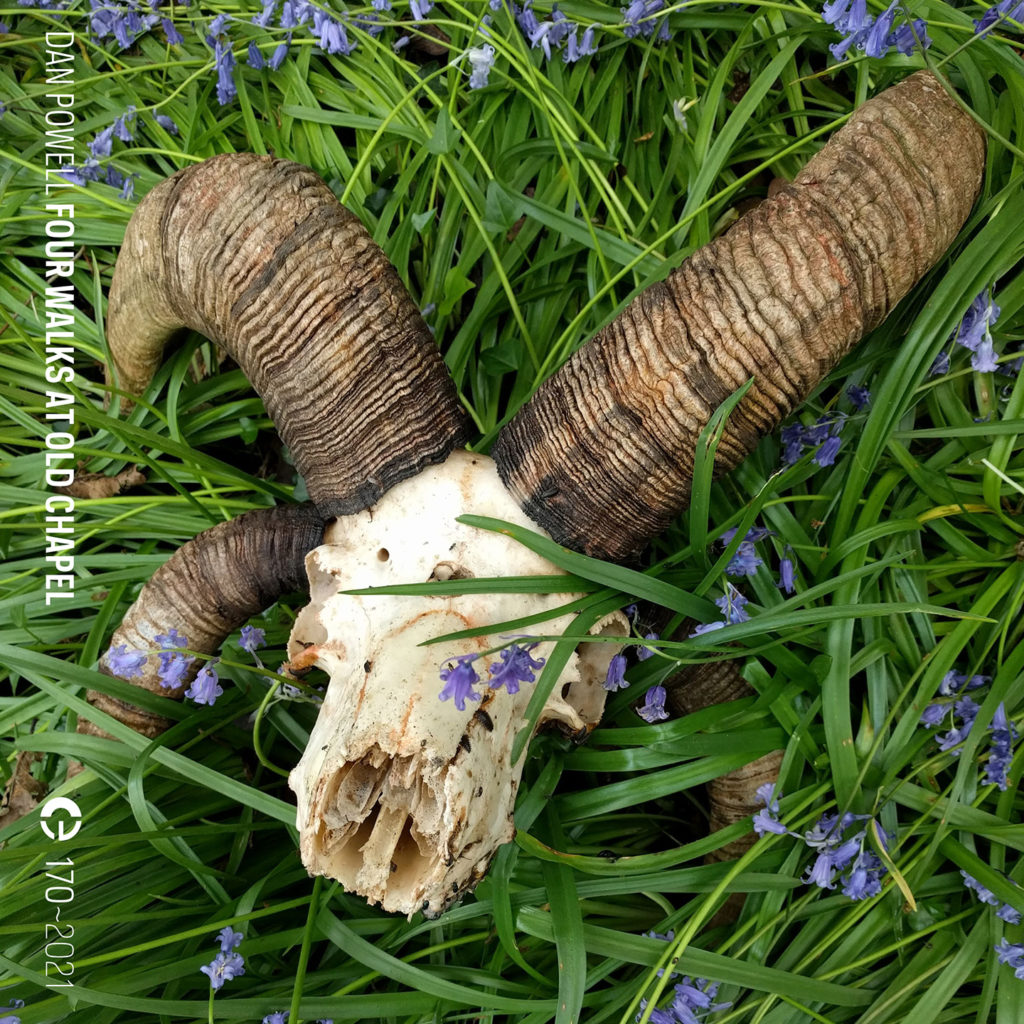
Recorded at Old Chapel Farm, Wales, 2016-2018 by Dan & Bea Powell. Composed and produced by Dan Powell, Brighton, 2019. Mastering and cover by Miguel Carvalhais with photos by Dan Powell. Thank you to Fran, Kevin & Merlin Blockley, the Powell, Parker and Henderson families.
“Four Walks at Old Chapel†is now available as a limited release tape, and for download or stream.
Dan Powell, von Haus aus Fotograf und seit Jahren auch in den Bereichen Installation und Field Recordings aktiv, dokumentiert in seinem neuen Tape den subsistenzwirtschaftlich orientierten Betrieb der Old Chapel Farm in Wales. Ausgangsmaterial waren eine Vielzahl von Objekten, die in verschiedenen haptischen Bearbeitungen zu Klingen gebracht wurden, zudem die geräusche der umgebenden Natur und Musikinstrumente, die sich im besitz der Bewohner befinden. “Four Walks at Old Chapel†ersheint Mitte Mai bei Crónica.
At the time – early 2017 – I was actually finishing an album that focused on all of my water and sea-related field recordings. While reading the text and its background more closely suddenly, the contours of a potential musical project centred around this poem started to emerge.
So, I thought, perhaps I should not try and get to the bottom of what is actually written down? Maybe I should just let myself be taken into the maelstrom of thoughts that are presented? After all, I wasn’t doing academic research. I was just fascinated by the poem, first by its visual presentation and then by the stream of images of vessels on an endless ocean, of tiny ships tossed around in giant storms, of shipwrecks at the bottom of the sea, of ships’ captains helplessly overwhelmed by thoughts and realisations.
The process:
Work started some time early 2016 when early on i decided that the poem was to be recited. It was going to be a work of significant proportions, representing the endlessness of the journey. And every plate of the poem gets its own track. I asked my dear friend Valerie Vivancos to recite the poem, to which she agreed, and I sent her the text with sparse instructions. This wasn’t an easy task because of the fragmented nature of the text, and her performance was excellent.
The struggle I mention above mostly deals with how strict or how liberal I should take the structure of the poem. Like I read somewhere that each plate consisting of two pages was divided into four sections where the words were spread out according to the number of syllables used. I have been thinking about how to use that structural principle in the music as well, but I concluded that it was an operation as much impossible as it was futile. Some things just cannot be translated from one art form into another without compromise or corruption.