


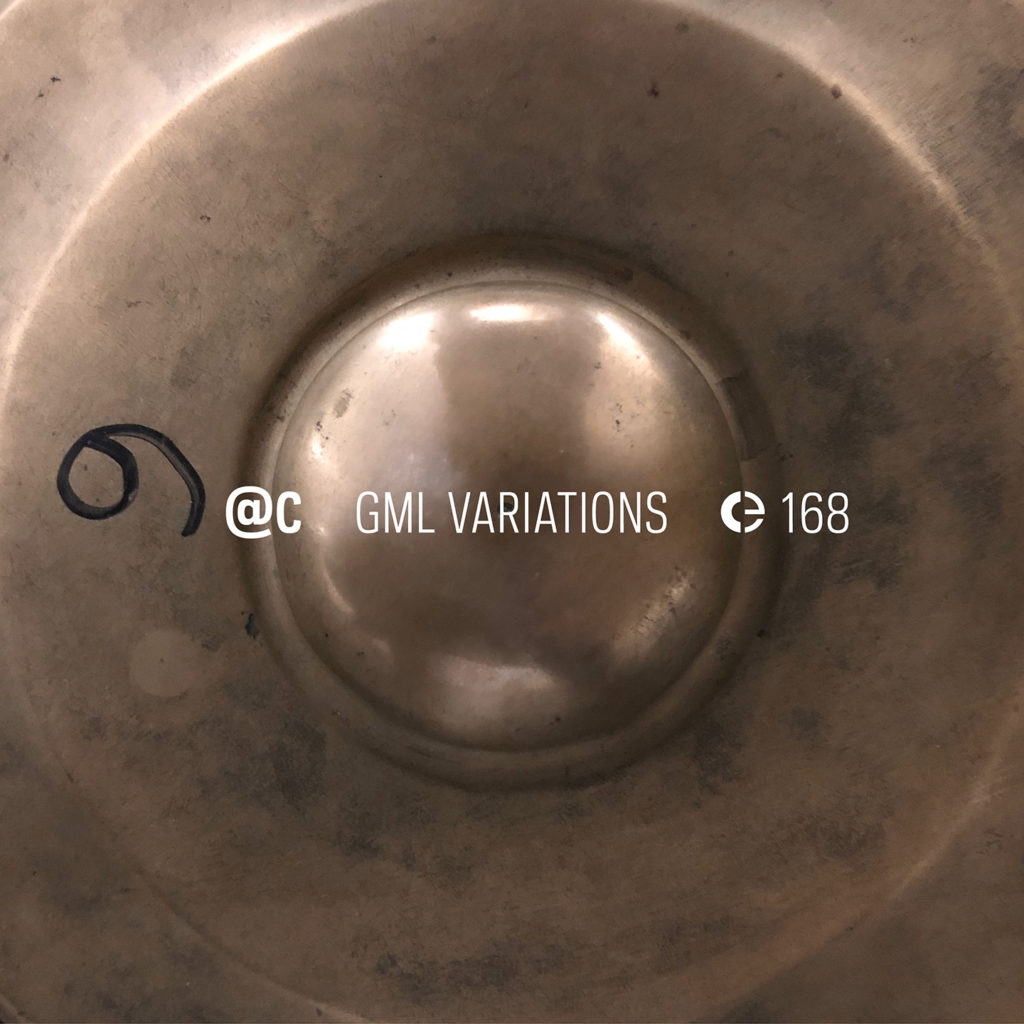
The new @c album, GML Variations is now available to download or stream. There are also still some copies available of the limited release CD in a gatefold sleeve, so get them while you can.
GML Variations started with a commission to compose a piece for the Robotic Gamelan of Casa da Música, in Porto, to be presented with other works in a public showing spanning several days. GML 123 was a generative system that controlled the actuators in the Robotic Gamelan while projecting several other sounds into the very resonant space of Casa da Música’s foyer. The piece was presented in January 2018 and shortly afterwards recorded in the same location. After receiving the recording, we found ourselves being drawn to it over and over and, as often happens to us, we started experimenting: revisiting the original composition, manipulating its recordings and creating new material, eventually developing the four variations and coda that complete this album.
During this process, we were unearthing echoes and memories of the first composition, transforming the original sounds to the limits of recognition, and finding structures that were already latent in, but were not expressed by, the initial piece. These pieces are therefore not six independent compositions but rather six different perspectives over a single work, six ways of listening to it.
In the course of this work, we developed a seventh piece, Jeden, Dwa, Osiem (dla Małgorzaty), published in the compilation Intermediale: Simulacra Soundscape 3. We also performed versions of the variations in a stream for Audiotalaia during the first lockdown of 2020, in a performance with André Rangel at Rivoli, Porto (in which we worked on for almost a year, and that we first had to postpone and ultimately cancel because of the pandemic), and in a concert at Passos Manuel, Porto (released as the GML Vars. Live single). GML Variations closes this cycle of work, at least until we find ourselves drawn to this material again.
Pedro Tudela and Miguel Carvalhais collaborate as @c since 2000, composing, performing, and creating sound installations. They have released and performed extensively, often collaborating with other artists and collectives in a practice marked by radical experimentalism with computational sound. In 2003 they established Crónica, a label dedicated to experimental music and sound art, that they have run since.
Tracklist:
All pieces composed by Miguel Carvalhais and Pedro Tudela. GML 123 was commissioned in 2018 by José Alberto Gomes and Digitópia for the Robotic Gamelan of Casa da Música in Porto (developed by Rui Penha, José LuÃs Azevedo, and Miguel Ferraz). GML 123 was recorded by Tiago Ângelo in 2018 at Casa da Música. GML vars. 1–4 and GML coda were composed in 2019 and 2020.


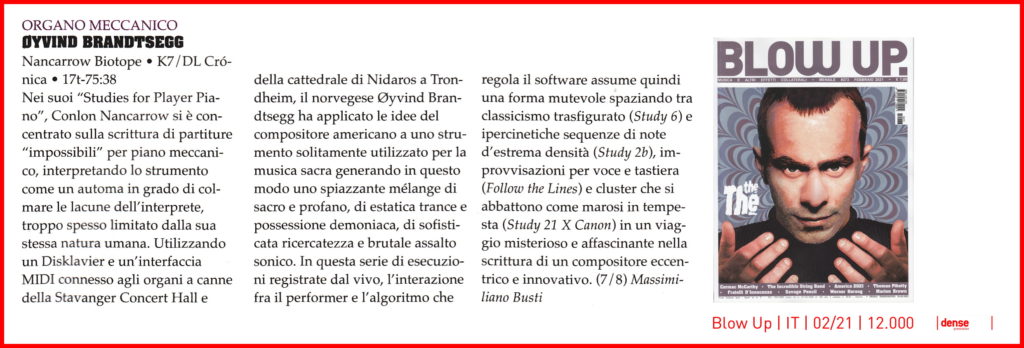


Roel Meelkop is a Dutch hero of sound art who I find it convenient to put in a Netherlandish seraglio with Peter Duimelinks, Jos Smolders, Frans de Waard and Machinefabriek. Indeed we last heard from the Roelster on the Cryptonesia record where he performed as Wieman (with de Waard) to produce an extensive reworking of two cassette tapes by Cybe. That was in 2017. Now in 2020 he’s getting into the exciting area of modular synthesis (I think this is getting easier to do with the invention of DIY miniature devices like Plumbutter, but I don’t really know an awful lot about it).
Meelkop combines tapes from his large collection of field recordings with sessions of modular synth work, and that’s what we hear on today’s cassette Crossmodulated (CRÓNICA 163-2020), which in title is a very descriptive name for the process and for the results, you’ll admit. Roel freely owns that he is borrowing the methods of Jos Smolders, who did it recently on his album Nowhere, released on this same label in 2017 and noted here. Roel has been grateful for the introduction to modular synthesis and feels that his studio work has been given a new lease of life by it. On these five Crossmodulationexperiments, our man is already exhibiting supreme control over these audio events, mastering the forces that swell and rise like the rare undersea balloon fish of Bermuda. One can barely detect any “real†sound that may have survived from the field recordings (with the possible exception of odd voice-like murmurs on #3 and #5), but the process that’s relevant is more likely to be the way that sounds are sculpted and shaped by the hummulating and juddering of the black boxes, whatever devices they may be, hopefully cross-linked by various cables and jacks inside Roel Meelkop’s powerhouse of a studio.
The general pattern of execution seems to require that a piece starts out small and uncertain, then gradually grows into an unstoppable landau of pulsatering noise, firing out poison pellets and radiating waves of alien ray-gun force as needed. True to its name, this whole tape is a gardener’s delight of cross-breeding and transplanted strains of buds growing inside other buds. Fave cuts for me are #1 and #2, as they seem more inclined to whizz away out of control at crucial moments; #4 just scowls and sits there like a lump of sour dough that’s daring us to throw it in the trash bin, and #3 is intriguingly mysterious but also feels a little throwaway. ‘Crossmodulated 5’ exhibits minimalist tendencies that Machinefabriek would probably commend; in fact, the dancing on head-of-pin tiny dots of sound would have their place at the annual Asmus Tietchens tribute festival, an event which I just made up, in Stuttgart. From 2nd October 2020. Ed Pinsent
The TBA Podcast features @c work in its most recent episode, looking at their sound installation VOC(x), which should have opened last April but was delayed by the pandemic. The mix created for this podcast looks at one among many possible articulations of the piece that will hopefully open one day.
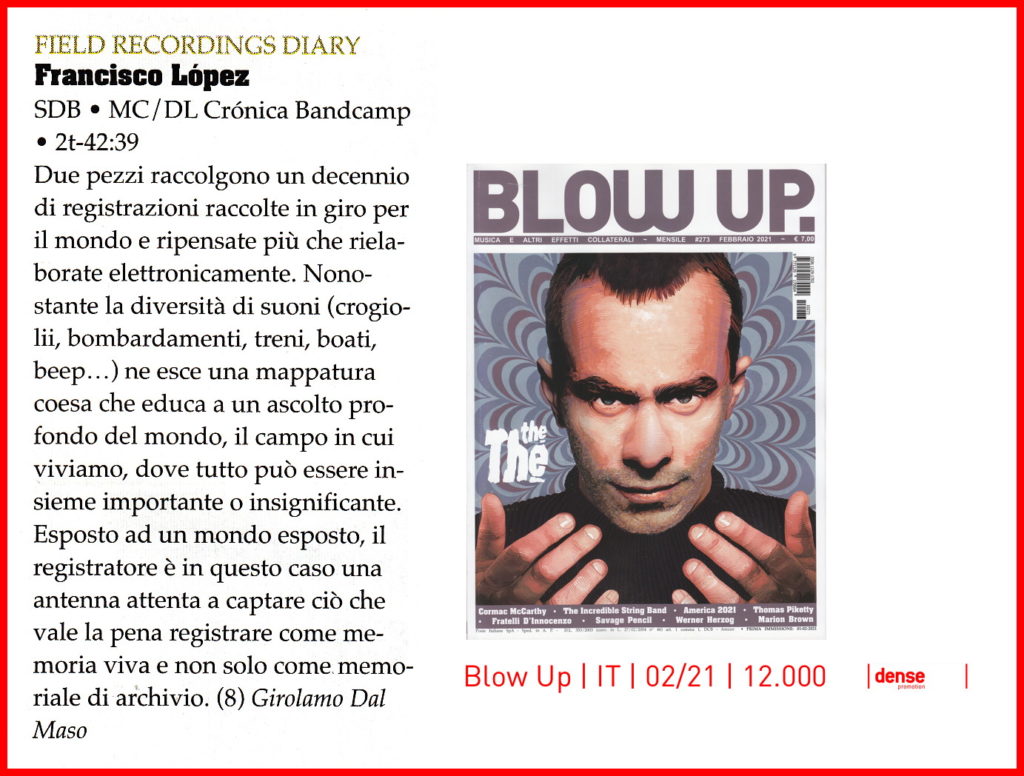
There’s a quality that some music has of being like an old friend. I’ve not listened to any new Francisco López in a decade or more but the ’00s CDs of his I have get a fairly frequent spin. Those CDs tended towards a kind of quietism — usually called Untitled [n] and largely a kind of textural building from exceptionally quiet to pretty blaring. All with exquisite attention to sonic detail — you could nominally call it “noiseâ€, but you’d be a fool to do so.
So what’s he up to in 2021? Well this apparently spans 2009-2019, so difficult to say precisely, but this seems to be collected and processed field recordings. And in proper sound-art fashion, there’s not quite enough material here to give a clear idea of the sorts of environments being recorded — is that a watery sound or just some squelchy noise?Train station or generated rhythm? Submerged mics or studio trickery?
It’s always difficult to know with López whether there’s a narrative or if he’d prefer that the listener make their own mind up about what’s being heard. Here he’s perhaps avoiding the intense building of the work I’m familiar with, preferring something more like a contraction and expansion of different elements — incidental office environment sounds maybe, digital burrs.
López is tricky to recommend in a specific way, I think. This is effectively some field recordings. Those are interesting or not, depending on the listener — I could imagine this being super compelling to someone unfamiliar with that world, and is doubtless compelling to someone already familiar with that world. He’s certainly one of the greats of this quite specific sound-art — plenty of forensic mic-detail but never too clean or asceptic with it, he’s capable of exquisite beauty but doesn’t have the sort of fidelity fetish that can render this sort of material dry and academic. Which is to say, he’s by a large margin one of the best at this kind of thing.
There’s a smidge of composerly drama — and it’s worth having a go in a darkened room with decent headphones — but not so much as to be romantic or, dare I say it, musical in too specific a fashion. The second piece is perhaps the quieter of the two (though neither is much louder than ambient for any length of time) and it keeps making me wonder if he’s doting on the tone of the ambient noise within a given environment — almost like he’s bringing forwards the ambient background hum.
It’s a lush album. It’ll have the problems that these things often do — it definitely demands a decent listening environment and half-decent gear. It’s definitely the sort of thing hi-fi bores should use to show off their stereo equipment. And he’s probably the best in the album-based sound-art game, for my money. Kev Nickells
via Freq
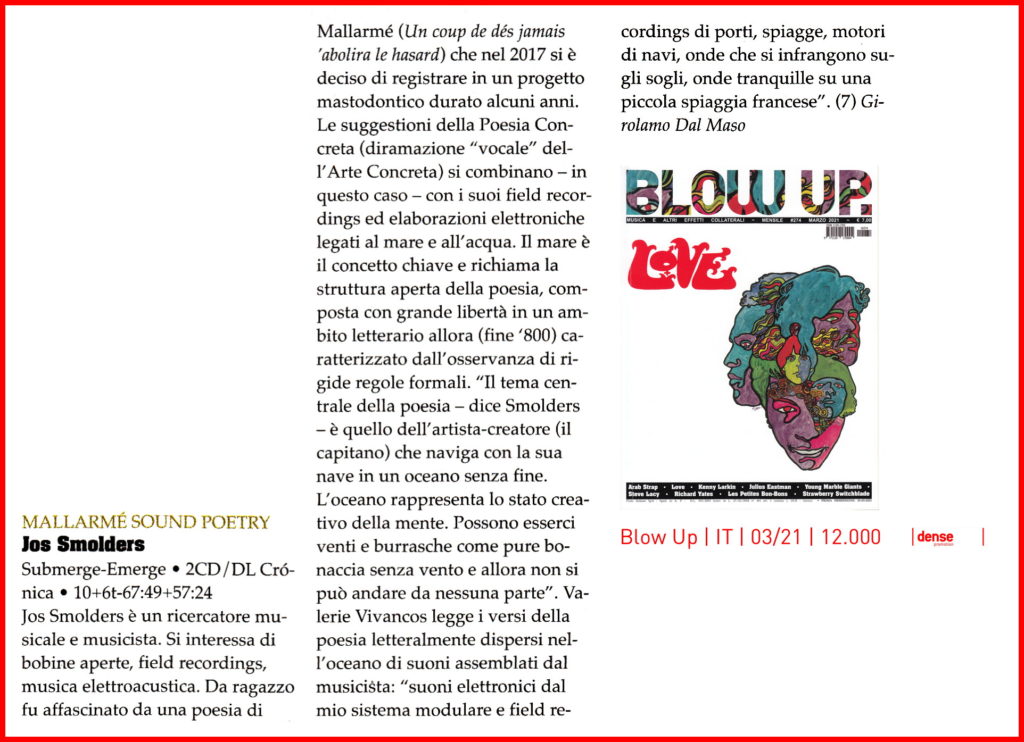
You can trust Dutch electroacoustic composer and sound artist (and mastering engineer) Jos Smolders to come up with amazing sounds. After all, he has the experience of experimenting for more than 35 years – learning to work with “a combination of instinct, talent, skill, and patienceâ€.
Submerge-Emerge, released on Crónica as a 2-CD set and digital download, presents a fascinating otherworldly soundtrack based on Stéphane Mallarmé’s poem “Un Coup De Des Jamais N’Abolira Le Hasardâ€Â from 1897 (which translates as ‘a roll of the dice will never abolish chance.’). When he read the poem in his teenage years he was fascinated – though it was more because of the way it was printed than by the words themselves (check the link above for a preview and translation). Forty years later, around 2016, he explored the poem again and this time it inspired him to create this project.
“Reading the poem, one gets easily lost. These are no firm and consistent sentences. It’s not a sequence of sentences telling a story, and there is no clearly definable plot.â€
Some of this also translates to the music. It is presented in sets of ‘plates’ (the poem’s printed pages), divided by an “interlude†after every two of them. Fragments of the poem are recited by Valerie Vivancos in a beautiful voice that is somewhat alienated by electronic processing.
Most of the sound is related to water – combining field recordings of “harbours, beaches, ships’ motors, storms, waves breaking on the rocks, the quiet lapping of waves on a small French beach†with the electronics of Smolders’ modular system. But this does not imply that the result sounds like anything out of this natural world.
“The central theme of the poem, at least what I got out of it, is that of a creator/artist (the captain) sailing the endless ocean on his ship. The ocean represents the creative state of mind. Sometimes there are prevailing winds. On other occasions, huge gales toss the ship around with towering waves moving everyone off course, if not sinking the lot. And then there are the doldrums, the parts where, yes, the sea is calm, but there is no wind, and you’re not getting anywhere. Looking back at my own experience as an artist, I have seen all these weather conditions as well.â€
It took a long time before Smolders understood the poem’s intention, and he still doubts if he fully understands it. Likewise, it took him five years to complete the poem’s translation into music. “Five years to record, compile, rethink, leave it alone, get back, reform, cut, add, alter, and finish this beast that at times itself became an ocean of sound and form. It is time to cut the ropes to this vessel and sail on. I hope it inspires, because “toute pensée émet un coup de dés†!â€Â (every thought rolls the dice).
And now it’s the listener’s turn to dive in deep, to submerge himself in this impressive set of soundscapes, and to emerge refreshed – and perhaps also puzzled.
via Ambientblog