

Juin, mois des chouchous. En provenance du Portugal, précisément du Théâtre de Marionnettes de Porto. Abonné depuis leur ‘Ab OVO’ de 2014, le duo @C renouvelle l’expérience sur ‘Three Body Problem’ (Crónica, plus que jamais). Les premiers instants sont énigmatiques, le temps de défricher le terrain. De percevoir les acquaintances avec Peter Rehberg, de se rappeler de ses rapprochements avec Giselle Vienne. Puis vient l’éclaircie salutaire. Pas besoin d’imaginer les figures manipulées en souterrain, les sons explosent à la figure. En toute décontraction noise. Sans agressivité, avec un sens de la glisse bruitiste exemplaire. Ponctué de quelques interventions extérieures, dont les remarquables gongs et cloches de Joao Pais Filipe (‘112 (Pace)’), on imagine poindre le Bell Orchestra. Ou le souvenir de Joanna Newsom, merci la harpe d’Angelica V. Salvi. Que décidément, Miguel Carvalhais et Pedro Tudela manient l’art des contrastes. De l’impressionnisme au revendicatif, de la lenteur à l’excitation, leurs neuf déclinaisons sectionnent les mauvaises habitudes. Allelujah. Fabrice Vanoverberg
New in the Corollaries series: Fernando Godoy’s “Is the space empty, only to be filled with the energy of this voice?â€
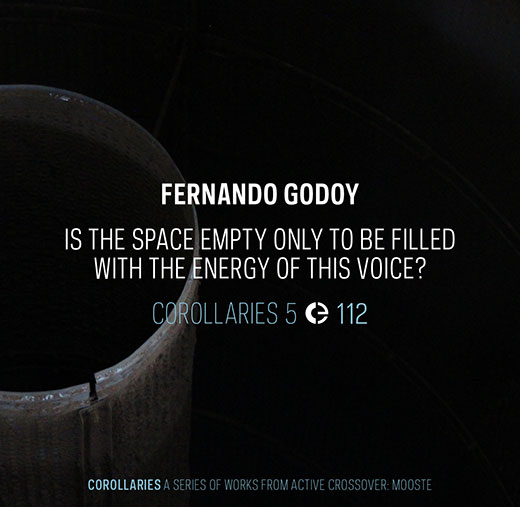
This is the fifth release in the series Corollaries, that compiles works resulting from Active Crossover: Mooste, a cross-cultural collaborative residency curated by Simon Whetham and hosted by MoKS, in April and May 2015. All works are composed from material compiled in a collective archive during the project.
This piece was made using field recordings of the resonance of empty spaces, activated by speech. As Alvin Lucier described in his piece ‘I am Sitting in a Room’, after many repetitions (of record and playback) the sound of the voice becomes the sound of resonant frequencies of the place. So what you hear as raw material in this piece is the natural frequencies of different spaces reinforced by the repetitions of the voice recording procedure. The voice works as an excuse to capture the sound of empty place.
Using that resonance as main material, the piece was composed reinforcing and isolating frequencies by equalization, but no other audio processing was used.
This work is one of the results of my residency at MoKS, where in collaboration with Simon Whetham, John Grizinch and Arlene Tucker, we made many recordings of this voice-resonance procedure at abandon ruins: a water tank, a mill, a pig farm, a empty glass tube from a second hand shop, a silo, an oil tank, internal and external spaces.
Is the space empty, only to be filled with the energy of this voice? is a free download from Crónica or Bandcamp.
“Bittersweet Melodies†reviewed by RNE3 Atmosfera

Bittersweet Melodies supone su undécimo álbum, un trabajo que se sumerge los atardeceres ambient, el negro Oriente Medio, zonas tranquilas con atmósferas utópicas o ritmos low-fi muy fracturados.
Encontramos en este Bittersweet Melodies material inédito disperso por discos duros relacionadas con una publicación con Mille Plateaux hace 12 años, justo antes de su inesperado cierre. Ahora se han reunido, remodelado, se les ha quitado el polvo, pulido, y remasterizado en esta nueva entrega de Ran Slavin.
Ran Slavin es un artista de múltiples facetas que trabaja principalmente con la instalación de vÃdeo, el sonido y el cine. Su trabajo explora las formas de ficción y narrativas a través del video y la instalación sonora que puede ser interpretado como una expansión de las formas cinematográficas. Su trabajo se centra en la tensión entre la realidad y la ficción, entre lo sobrenatural y lo mÃtico o la historia y el futurismo y obliga al espectador a pasear más allá de la realidad y de lo inmediato, en un entorno de superposición digital.
“Bittersweet Melodies†reviewed by Aural Aggravation
Given Ran Slavin’s broad artistic pursuits, which span video installation, sound and film, and his far-reaching interests which manifest in the exploration of the tensions between opposites, Bittersweet Melody is something of a summation of his preoccupations.
Just as ‘bittersweet’ is one of those words that encapsulates contradiction and juxtaposition, so Slavin’s latest album is built on contrasting sounds and forms. Culled and curated from pieces of work from Slavin’s archives and a release from over a decade ago, the material which comprises Bittersweet Melodies has been disassembled, reassembled and generally re-rendered.
A mellow organic drone hovers and hums through ‘Saturday’s Dress’, but the ambience is disrupted by very mechanical-sounding pings and spring and microtonal bleeps by way of irregular rhythms. A repetitive thrumming hum provides the framework for the minimal yet dense and sinister ambient hip-hop of ‘Category: Murdered Entertainers’, with distant snippets of exotica adding a heightened sense of the unfamiliar to its curious texture. Elsewhere, polyrhythmic percussion collides with stuttering trip-hop beats and eastern-flavoured scales entwine luscious soundtrack strings. Frenetic drum ‘n’ bass ballasts against shimmering electronic froth and looped vocal fragments wash in and out of rumbling scrapes, fear chords, dissonance and a rich soup of sound from all corners of the globe and of the recesses of the mind. Woozy ambience and glitchtronica waft into passages dominated by dank pulsations and murky, shadowy shapes.
The fragments evoke neither nostalgia nor excitement, but a sense of displacement, or alienation. How else does one respond to pan-cultural motifs overlaid and strewn with dancehall music and digital blips but with a sense of vague bewilderment? Slavin does not contrive to create a typical collage mash-up: Bittersweet Melodies is something altogether more subtle in many respects. Moreover, the contrasts and oppositions are moulded and melted into one another to as to become complimentary. Strange, disorientating and uncomfortable, with a lot happening simultaneously, but complimentary nevertheless.
Futurónica 167
Episode 167 of Futurónica, a broadcast in Rádio Manobras (91.5 MHz in Porto, 18h30) and Rádio Zero (21h GMT, repeating on Tuesday at 01h) airs tomorrow, May 27th.
The playlist of Futurónica 167 is:
- @c, 111 (Bacchanale) (2016, Three-Body Problem, Crónica)
- @c, 112 (Pace) (2016, Three-Body Problem, Crónica)
- @c, 113 (Advent) (2016, Three-Body Problem, Crónica)
- @c, 114 (Sleep) (2016, Three-Body Problem, Crónica)
- @c, 115 (Transcendence) (2016, Three-Body Problem, Crónica)
- @c, 116 (Cage) (2016, Three-Body Problem, Crónica)
- @c, 117 (Prophecy) (2016, Three-Body Problem, Crónica)
- @c, 118 (Reduction/Reflection) (2016, Three-Body Problem, Crónica)
- @c, 119 (Collapse) (2016, Three-Body Problem, Crónica)
You can follow Rádio Zero’s broadcasts at radiozero.pt/ouvir and Rádio Manobras at radiomanobras.pt.
New release: @c’s “Three-Body Problemâ€
Three-Body Problem is @c’s sixteenth full-length album, and their eighth in Crónica. Like the previous Ab OVO, this album started as a soundtrack for the puppet theatre play Agapornis, premièred by the Teatro de Marionetas do Porto in October 2014, and inspired in the life and works of Anaïs Nin. Three-Body Problem was (re)composed after the première of Agapornis, therefore it is not its soundtrack, but it is intimately intertwined with it, resulting from two sequential processes of composition.
The first of these lead to the play’s soundtrack. It was developed with the company during the rehearsals and work sessions in the process of creating Agapornis. Built to a script with two female characters (played with puppets) that were two poles over which the soundtrack should be developed, the composition started with an invitation to Angelica V. Salvi (harp) and Susana Santos Silva (trumpet) to record solo parts. These parts were used as building blocks, as two attractors over which 21 pieces grew, almost by aggregation.
The post-première stage of composition was focused on the album. This did not try to recreate the play, but rather to revise and recompose the music, building a related work that would inevitably draw much more than inspiration from the play.
In Agapornis, a third character with several spoken lines was played by an actor. In this second process, that symbolic role was enacted by the interventions of João Pais Filipe (cymbals and bells) and Ricardo Jacinto (cello and electronics), two musicians with whom @c have collaborated in the past. By doing new studio recordings at later stages of the composition, or by using archival material from previous sessions, these two new collaborations helped to bring Three-Body Problem to its final form with the 9 tracks now published.
Three-Body Problem resulted from a long, slow, and matured process of composition, spanning more than two years. This process resulted from the need to allow pauses in the compositional process, to allow memory to fade, and surprise to come into effect when (re)listening to the works in progress. But also to allow other works developed during that period (as live performances or sound installations) to contaminate, and occasionally infiltrate, the pieces.
This album goes to the core of @c’s working process: a process that emphasizes collaboration; a process that is highly conceptual and very structured but that embraces and searches for emergence; a process that is very plastic, treating sound as matter to be shaped and modelled and from which to grow the pieces; a process that is encompassing and dynamic, developed between studio, stage, rehearsals, performance, audiovisuals, installations, and other activities.
Agapornis was created by Isabel Barros, Edgard Fernandes, and Rui Queiroz de Matos. Puppets were designed by Júlio Vanzeler, built by Sandra Neves, Cláudia Armanda, and João Pedro Trindade, and performed by Micaela Soares, Ricardo Ribeiro, Rui Queiroz de Matos, and Vasco Temudo.
All pieces composed by @c (Pedro Tudela & Miguel Carvalhais) in 2014-2016 from the original soundtrack to Agapornis, by Teatro de Marionetas do Porto, premièred in October 2014.
Featuring: Angelica V. Salvi (harp in 113, 115, 117, 118, 119); Susana Santos Silva (trumpet in 111, 112, 113, 114, 116, 118); João Pais Filipe (gongs & bells in 112); Ricardo Jacinto (cello & electronics in 114, 117); Edgard Fernandes & Rui Queiroz de Matos (voices in 114).
@c live at SMUP
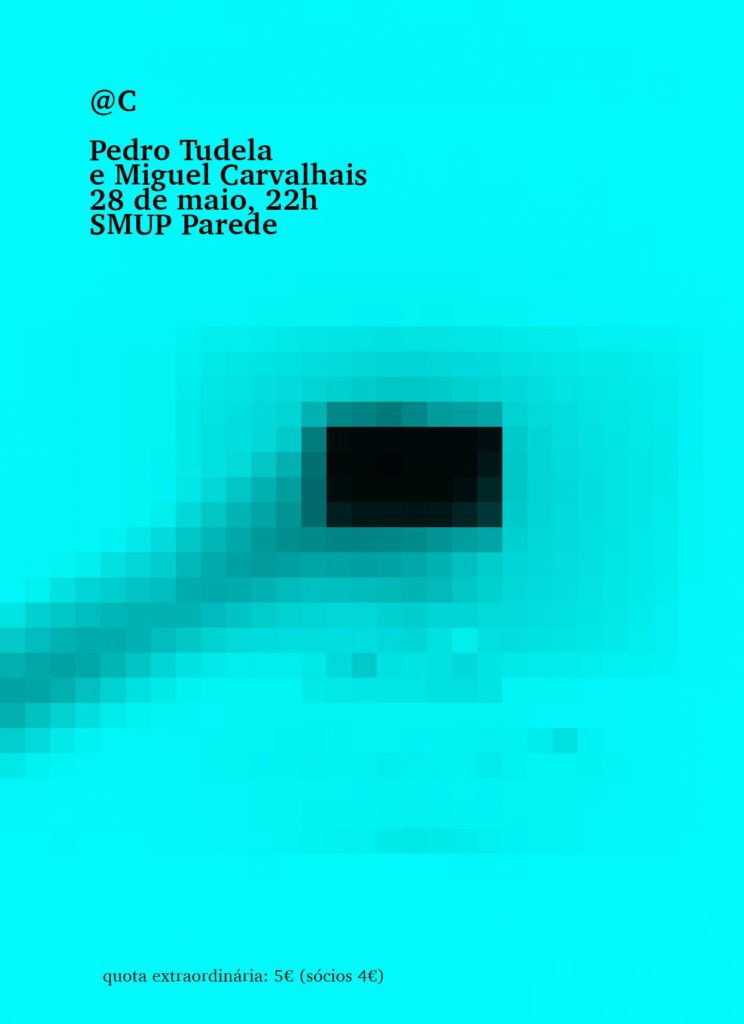
Next Saturday, May 28, @c (Pedro Tudela & Miguel Carvalhais) will perform at SMUP Parede. Copies of their new album “Three-Body Problem” will be available!
Soon in Crónica: “Is the Space Empty Only to be Filled with the Energy of this Voice?â€
“Bittersweet Melodies†reviewed by Blow Up
Slavin combina musica e video e ha un curriculum niente male. Questi sono pezzi rimasti non pubblicati nell’ultima dozzina d’anni. Pur nella varietà di sonorità e riferimenti si avverte una unità di fondo, une stile, forse meno appariscente di quanto sia in sostanza. Notevole il piglio narrativo, quasi un susseguirsi di scorci cinematografici o polaroid. Più che outtakes sembrano note ai margini. Girolamo Dal Maso
“Bittersweet Melodies†reviewed by Amusio
Der Israeli Ran Slavin ist in erster Instanz Multimedia-Künstler. Und weiterhin Musiker. Im weitesten Sinne. Sein Schaffen ist von arglistiger Täuschung sowie didaktischer Raffinesse gekennzeichnet. Die für ihn charakteristische Trennung von realen und irrealen Räumlichkeiten sowie das prozessuale Verfassen von sichtbar unsichtbar gemachten Zuständen schlägt sich auch auf seinem bereits elften Studioalbum nieder. Bittersweet Memories (Crónica) stellt zwar unentwegt Bezüge her, lässt diese jedoch derart resolut kollabieren, dass sich aus der Vielzahl der Optionen eine Lesart aufdrängt: die bittersüßen Erinnerungen sind die Vorboten einer in sich (und zurecht) verbitterten Weltwahrnehmung.
Die Titel sind bezugsreich gewählt: Category: Murdered Entertainers, Fake Sunsets, Dubai Dawn, Sinatra Was Here, Deserted New Buildings. Oder eben, selbstreferentiell: Collapsing Melody. Dennoch vermeidet Ran Slavin konsequent griffige Entsprechungen. Zumal das Album insgesamt eine Wirkung auslöst, die das Gewesene eines jeden Szenarios in die Nivellierung überführt.
Einzig der mit einer stoischen Verabschiedung von verbrämter Nostalgie schwingende Ausklang (Discreet Features) erlaubt einen Hinweis aufs Konkrete. Und selbst dieser wird allgemein (und umso verbindlicher) gehalten: Im Vernehmen der Zeit als Konstante der Vergänglichkeit wähnt sich die inflationär getaktete Imagination gegenüber dem Wert von Realitäten als haushoch überlegen. Auch wenn es sich bei diesem Haus nur um ein weiteres „deserted new building“ handelt.
Die seltsam vor sich hin plätschernde Gebrauchselectronica von Bittersweet Memories, die eine gewisse (und gegebene) Nähe zur Haus-Ästhetik von Mille Plateaux offenbart, entzieht sich der Verantwortung. Ihre Gegenständlichkeit transportiert weder Druck noch Appell. Und doch gelingt es, so denn überhaupt etwas gelingen sollte, einen soliden Schiedsspruch zu sedimentieren: Tempus fugit. Wer heute resigniert, kann morgen schon frei sein. Beunruhigend und verheißungsvoll zugleich, oder? Stephan Wolf
via Amusio