

In the cycle dedicated to music and performance, Pedro Almeida, João Hora and LuÃs Varatojo will perform a guitar trio tonight at 22h in Balleteatro in Porto.
“Lectures†reviewed by Vital Weekly

The other new CD is an odd-ball, certainly for a label like Cronica Electronica, who deal with laptop music and electronics. I have no clue as to what Piotr Kurek does to generate his music. Sometimes it seems like improvisations on acoustic percussion (such as in ‘Part 1’) but then something like ‘Tripartite’ could very well be a duet between accordion and laptop. The title refers to lectures given by Cornelius Cardew, who died in 1981, but whose son Walter has from lectures, performances and rehearsals. He handed them to Kurek, who used them in this work. An odd-ball, that brings up some questions, like what the relation is between the spoken word pieces by Cardew and the music by Kurek. Just inspired? Or is the music from Kurek all so spontaneous as Cardew wanted? Why not just add those as liner notes? In some cases music and talking mixes, which is nice, such as in ‘1963’, but when the talking is ‘solo’, it turned me a bit off. However the music here is quite nice. A most curious mixture of laptop music (I assume) and improvisation makes this something that is not heard often. Great one.
via Vital Weekly
Futurónica #4

The fourth and last Crónica broadcast at Rádio Futura, “Futurónica 04 — Xenochrony†by Miguel Carvalhais, will air from 10.30AM (GMT) today at 91.5FM in Porto or via stream.
“Erotikon†reviewed by Vital Weekly

Jorge Mantas, the man behind The Beautiful Schizophonic, is a romantic man – at least that’s what I think, as I never met him. For the press release he wrote a long text, dealing with erotics – and thus he creates a dreamworld of his own. His music, through the years he’s been active, is also of a romantic nature. String like computer sounds, a bit like Gas did, form the basis of all his compositions. Here he gets help from Yui Onodera, Sleeping Me and Christina Vantzou doing voices. Thus he carves out a fine niche of his own. Nothing abstract, nothing ‘nothing’, no mystery – just a plain guy (his own words) with a love for beautiful women and beautiful textured music. Ambient? Sure. Microsound? Of course. Something special? Mwah… no, not really. If you take the music face value, what is left is a beautiful woven tapestry of sound, very ambient, most suitable for long evenings near the fireplace. Nothing special. What makes it special is the context in which he brings us this music – that is a particular daring thing, to be so open about it. Nice indeed.
via Vital Weekly
“Lovely Banalities†reviewed by Kwadratuur

‘Lovely Banalities’ is de tweede cd-release van Litouwer Gintas KraptaviÄius (kortweg Gintas K) op het Portugese Crónica-label. In 2006 bracht hij het dubbelalbum ‘Lengvai / 60 x One Minute Audio Colours of 2kHz Sound’ uit, waarbij hij onder het goedkeurende oog van de verzamelde gespecialiseerde pers een cd met experimentele, minimale microtechno koppelde aan een geluidsstudie van 2kHz-geluiden. Op ‘Lovely Banalities’ doet Ginta K iets gelijkaardigs, al wisselt hij ditmaal op één en hetzelfde schijfje een reeks veldopnames af met kleine, opnieuw redelijk korte digitale geluidswerkstukjes.
Net als heel wat van zijn collega’s heeft KraptaviÄius een voorliefde voor onherkenbaar verminkte, digitale geluiden en artefacten. Meer dan eens bewerkt hij aanvankelijk redelijk conventioneel klinkende synthloops met distortion-, delay- en bitcrush-effecten tot vervaarlijk knisperende, fluitende en stuiterende geluidsprojectielen. Wie in deze sonische spielerei op zoek gaat naar structuur of een ‘verhaal’ is er aan voor de moeite: Gintas K maakt abstracte geluidsschilderijen, geen songs. In tracks als ‘Music Box’ en ‘Found Feelin’ duikt er uitzonderlijk een (kinderlijk eenvoudig) melodietje op, maar voor de overige veertig minuten speelt de Litouwer klinische, onaardse stereospelletjes die soms meer weg hebben van een gehoortest dan muziek. De korte stukjes zomerse tuingeluiden die de verschillende meanderende niemendalletjes aan elkaar linken, dragen weinig of niets bij aan de plaat.
‘Lovely Banalities’ zal ongetwijfeld in de smaak vallen bij de harde kern van fans van alternatieve elektronica, maar voor de modale muziekliefhebbers is dit soort digitale experimenten hoogst waarschijnlijk een kwelling voor de trommelvliezen. Hier en daar duiken interessante klanken en ideeën op, maar van genieten van is geen moment sprake. Filip Martens
via Kwadratuur
Futurónica #3
The third Crónica broadcast at Rádio Futura, “Futurónica 03 — Cool-age†by Pedro Tudela, will air from 11AM (GMT) today at 91.5FM in Porto or via stream.
Ran Slavin’s “Everything Is Urgent†in Paris
Today and tomorrow at VIDEOFORMES @ FESTI VALDEMARNE, Paris.
@c live at Rádio Futura
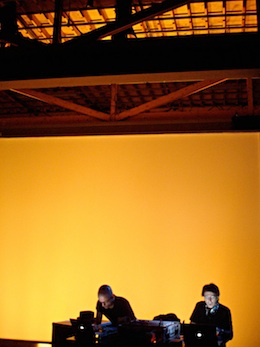
Starting in 15 minutes at Rádio Futura. Tune in to 91.5FM or to the stream.
Rif Raf profiles Crónica

Porté sur les fonds baptismaux en 2003, le label portugais Crónica est véritablement issu de la rencontre entre les musiques électroniques et les cultures digitales. A l’instar des multiples installations et collaborations qui entrecroisent monde des arts plastiques, pratiques scéniques et univers musical, la maison de Porto s’inscrit dans une démarche souvent radicale, certes. Elle est toutefois, et plus souvent qu’à son tour, une immense bouffée d’oxygène libre dans un monde où les conformismes de tous les suiveurs ont bien trop souvent pignon sur rue.
Emanation du trio, aujourd’hui duo, @c, Crónica est issu de l’imaginaire fertile de deux de ses fondateurs Miguel Carvalhais et Pedro Tudela, avides de mettre sur pied « une plateforme pour réaliser, distribuer et promouvoir leurs propres réalisations et celles d’autres activistes ayant les mêmes préoccupations esthétiques’ » (interview parue dans la magazine MCD n°22, juin 2004). Entièrement fondé sur une vision numérisée de la musique qui tient cependant plus de la performance multimédia que de l’art de faire danser les foules, le catalogue de la maison lusitanienne s’est enrichi d’une quarantaine de titres, dont le fameux ‘Happiness Will Befall’ de notre Australien préféré Lawrence English ou le plus ambient ‘Hidden Name’ des excellents Stephan Mathieu et Janek Schaefer. Les trop rares spectateurs présents un soir de février au Netwerk d’Alost ont pu le vérifier, la très bonne réputation du label n’est pas un vain mot, comme en témoignent trois sortes récentes, dont le magnifique ‘Lovely Banalities’ de Gintas K, notre recommandation absolue du moment.
Disponible en téléchargement libre, avis aux aficionados fauchés de la noise ambient, le double album ‘Compilation Works 1996-2005’ retrace le parcours hautement agnostique du producteur allemand Marc Behrens. Première sortie sur le web autorisée par son auteur, les dix-neuf projets nous entraînent dans un – parfois – éprouvant voyage électronique, aux frontières malléables et translucides. Entre réinterprétations d’artistes contemporains (John Hudak, TV Pow, Ilios et quelques autres) et retours sur ses propres compositions, la toute grande majorité des tracks présentées est – avant tout – pleinement conceptuelle. A l’instar du morceau initial, dédié – et oui – à la Coca-Cola Company, la matière sonore s’applique en transformer en instants audibles des éléments inaudibles, au sens premier du terme (la lumière, dans le cas présent, est convertie en sons, cela donne une splendide fluidité qui évoque les installations sonores de l’artiste français Denys Vinzant). A l’évidence, la patience est de prime vertu quand on aborde l’abstraction behrensienne. Tantôt aux prises avec le non-événement, réfugiée entre silence et chaos, la vision développée par l’homme de Francfort ne laisse pas de poser des questions sur la notion même de matière musicale. Pleinement idiosyncrasique et bruitiste, son oeuvre évolue, n’ayons pas peur des mots, dans les marges de la marge. Quelque part aux extrémités d’une planète peuplée de tous les Yasuano Tone et Gert-Jan Prins en devenir, l’ampleur de son regard distancié, voire intellectualisant et narcissique, demandera à l’auditeur – quoiqu’il en soit – un effort certain de compréhension, voire d’abandon de soi. A vous de juger, d’autant que son écoute n’allègera votre portefeuille du moindre centime.
Second effort de l’artiste sonore lituanien Gintas K, ‘Lovely Banalities’ est nettement plus intéressant à notre point de vue. Successeur du très bon double album ‘Lengvai / 60 x One Minute Audio Colours Of 2 kHz Sound’, le disque est tout sauf… banal. Composé de quatorze miniatures que l’auteur n’hésite pas à comparer aux ‘Tableaux d’une Exposition’ du compositeur russe romantique Moussorgsky, l’oeuvre alterne moments de musique digitalisée et field recordings – le cours d’une rivière, la pluie – enregistrés à Marijampole, ville de résidence de notre homme. Certains titres sont absolument remarquables de justesse harmonique et de précision dynamique. Ainsi, l’introductif ‘In’ intègre en toute fantaisie une menace extra-terrestre bourdonnante éprise d’Andrei Tarvosky et de bruits épars, dont un drone obsédant bien que familier. Le second titre ‘Q’ est tout aussi réussi. Evoquant la pulsation d’un téléphone qui sonne occupé revisité par les Boards of Canada, la track est traversée par un brouillard épars d’où l’on s’attend à voire surgir le commandant Spock aux manettes d’HAL 9000. Traversé, d’une manière plus globale, de ses sonorités banales – au sens le plus étymologique – du quotidien, ‘Lovely Banalities’ n’est cependant pas qu’une exploration de plus des non-événements d’une vie sans relief. Puisé dans une inspiration jusque dans ses meilleures sources, l’essai emprunte autant à alva noto (‘Something In The Grass’) qu’à Svarte Greiner ou Lawrence English (‘HH3’), sans même parler des évidentes connections dépoussiérées avec la maison Editions Mego, (‘C2’, ‘Just 1’). Vous l’aurez compris, nous sommes – très – très fans.
En téléchargement libre, elle aussi, la troisième sortie de l’année de l’étiquette portugaise est complètement invraisemblable. Condensée en 4GB de données informatiques, l’intégralité des morceaux présents sur ‘1001 Songs of eBay’ tient, accrochez-vous au lustre, en deux jours, trois heures, quarante et une minutes et vingt six secondes, pauses clope et visite au frigo non comprises. Parfaitement invraisemblable, d’une loufoquerie démentielle dont on ne sait trop s’il faut l’admirer ou la moquer, la démarche est le fait de la collaboration du collectif viennois Ubermorgen.com et de l’artiste tout autant viennois Stefan Nussbaumer. Pleinement en adéquation avec la recherche des premiers en matières de sécurité informatique et de respect de la vie privée, les mille et unes tracks transforment les données personnelles d’utilisateurs d’eBay – vous, moi, tout le monde – en des morceaux electronica étonnamment, croyez-le ou pas, minimal dance. Toujours appuyés par des beats secs d’une étonnante teneur squelettique, elles ne sont pas évoquer le label Raster-Noton, les rythmiques saccadent des restes de mélodie clairsemées et pourtant vivaces. Toutefois, et pour la petite centaine de plages que nous avons écoutées, la très forte ressemblance entre les diverses pièces force à un exercice d’équilibre post- autechrien difficilement soutenable sur la longueur. On renverra donc aux sélections proposées sur le site du label, chacune d’un volume de 60 MB et variable selon le moment du téléchargement. Fabrice Vanoverberg
Futurónica #2
The second Crónica broadcast at Rádio Futura, “Futurónica 02 — Radios & Guitars†by Pedro Almeida, will air from 10AM (GMT) today at 91.5FM in Porto or via stream.